✒️ Note-Making
Clarify
🔈 Summary of main ideas
- You don't have to sell your soul - Marketing is not inherently bad or evil. You don't have trick your clients or use sleazy tactics. On the contrary, by being you, providing value and having integrity you'll be a better creator and marketer
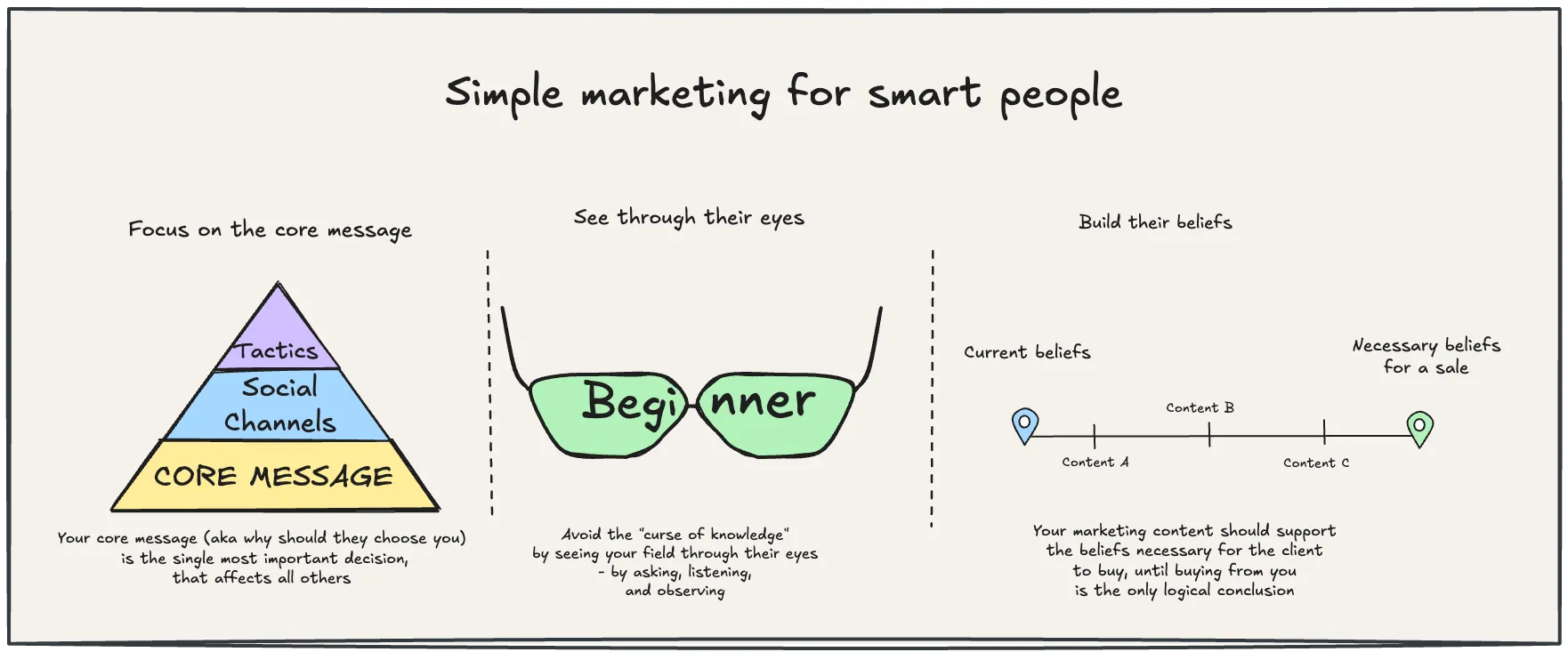
- Put yourself in their shoes - We tend to over complicate thinks, we get tripped by the curse of knowledge, thinking from our viewpoint after spending weeks/months/years diving into a topic. This is great for our expertise, but bad for our marketing. We need to imagine what it's like to be someone who isn't familiar with our topic, what their beliefs are, how they see the world, what do they need most.
- Focus on upstream decisions - Instead of focusing on the nitty-gritty of marketing - like which channels to work on, which tactics to use, it's better to focus on the decisions that matter most - which is our core message. A bad message won't sell even with the best tactics, while a good message can prevail even bad strategies. You must answer the question "Why should they choose you".
- Target the beliefs they need to have to buy - Think of the list of beliefs a customer needs to have in order to buy from you. The usual suspects are agreeing on the problem, on the solution, and that you're the best solution they can have. Your marketing content needs to "take them by the hand" from their current beliefs until they have all the beliefs necessary for a purchase, and then your product will sell itself.
- Every claim needs a proof - They won't believe you just because you told them so. Either with stories, evidence or testimonials, you have to provide credibility to your claims.
- You have to do it - The product won't sell itself, and there's no one with your type of expertise that you can delegate the marketing task to. You can hire someone to build your website, but not it's message.
Relate
⛓ by following this method, what will happen? What is the goal of this book? To become a better marketer, to be able to use your time wisely generating quality sales, without feeling dishonest.
Act
📋What should I do to achieve the goals set out by this book? Here are the 10 most important actions, workflows, or habits derived from the book notes:
- Be Yourself and Provide Value – Focus your marketing on your authentic self and delivering genuine value to customers.
- Understand Through Customer Eyes – Approach your product from the customer's perspective, focusing on why they need it, not why you want to sell it.
- Simplify Your Message – Avoid overcomplicating marketing, as simplicity makes communication clearer and more effective.
- Retain Marketing Decisions – Delegate marketing tasks but keep the strategic decisions under your control, as you best understand your business.
- Define Your Core Message (Upstream) – Clearly articulate why someone should choose your product or service, as this guides all your marketing content.
- Ask "What Beliefs Lead to Buying?" – Regularly ask what your clients need to believe in order to buy, and focus your marketing on building those beliefs.
- Identify Customer's Current Beliefs – Actively listen to questions, ask "what/how" questions, and observe patterns to understand what your prospects already believe.
- Build Beliefs with Claim & Proof – Structure your marketing content by making a claim and then supporting it with relevant proofs (ethos, pathos, or logos).
- Experiment with Marketing Channels – Use different marketing channels to test responses, and then focus your efforts on those that prove most effective.
- Market Genuinely and Address Core Concerns – Avoid manipulative tactics; instead, focus on being honest, providing value, and answering "Why should they care?", "How are you different?", and "How can they trust you?".
Critique
🧩 relevant research, metaphors or examples that helps to convey the argument
- Upstream vs downstream decisions - Upstream decisions create a path dependence for all the decisions that comes after, so it makes them more important and impactful than the "downstream" decisions. Things like which house to live in is more impactful than which furniture to bring.
- Belief building - To focus on changing the customer's beliefs until they have what's needed in order to buy
❌ the logical jumps, holes or simply cases where it is wrong...
🧱 Implementations and limitations of it are...
Review
💭 my opinions on the book, the writers style... Even though they focus on "honest, good marketing", I can feel like they're trying to give compliments to turn us into loyal customers. From the title of the book "for smart people", to their tone throughout the book. It feels sleazy, even though they go against it.
Also, there's little synergy between the two writers. They labeled the author of each chapter, and most of them are by the marketing guy. Tiago is just there to serve as the use case of the book's message, and I guess to be a living testimonial.
Outline
📒 Notes
Introduction
Marketing it tough, but it can be made simple. It's not only for the super extrovert marketing people, and it doesn't require you to be someone you're not.
The tldr is that you can and need to be yourself, to focus on providing value.
However, you do need to see it through the eyes of your customers, to see why they need your product, instead of why you want to sell it to them Mindsight is awareness of mental states in self and others.
- all this marketing complexity can too easily rob your attention from what matters most: your core marketing message. (Location 115)
- our best shot at success comes from being ourselves. (Location 153)
- How can you cut through that noise? You must meet your customers where they are and walk the journey with them to buying your product. There’s no skipping this step—it’s your only shot. (Location 155)
The Achilles Heel of Smart People
Smart people tend to over complicate things, because they have the capability of doing so. However this is a main disadvantage when it comes to marketing, because by making something complex, it becomes harder to understand and communicate Too much information prevents decision-making.
Also, the more we complicate things from the start, it becomes a form of Procrastination is delaying intended actions despite preference to act, which only hurts down the line.
Our early decisions (aka upstream decisions) have a lot of impact on how the rest of the process (aka downstream decisions) goes Past choices constrain future options and behavior. For example, choosing which software to use can affect all the products you generate, while trying out a new strategy will only affect the ones you try it on.
It's tempting to believe that we should stick with Specialization develops deep expertise by focusing narrowly on a domain, that we as the expert of our domain should focus on that and outsource the marketing to other people.
While we can delegate marketing tasks, such as website creation to others, we can't delegate the decisions. Others won't have the passion, the knowledge, and the point of view that we have. No one understands our business like we do. It's a tempting yet destructive thing to outsource our marketing to others.
- Avoiding upstream mistakes is crucial in both brewing and marketing. Good upstream decisions can often compensate for downstream errors. (Location 231)
- when you keep things simple, you free up the time, attention, and headspace to invest in what matters most. (Location 238)
- The mindset you had down in the weeds is not the same mindset you want to bring to the marketplace. You’ll confuse people with your technical talk. (Location 268)
- Nobody understands your business like you do. (Location 288)
I Can Relate
Trying to learn marketing can feel overwhelming, but at it's core, it's about talking to your clients in their language, understanding their needs.
Also, try to avoid these mistakes:
- It will sell itself - even amazing products require marketing. It's not enough to build something good and "putting it out there", you have to reach out
- Form over content - focusing on the product's "facade" like a nice website or a promotional video doesn't matter at the beginning. These are huge efforts that are irrelevant only to a much later stage
- Marketing is bad - we imagine marking as something "fake", sleazy, or deceiving. Marketing is not inherently bad, it's how we do it that matters. Good marketing doesn't even feel like marketing. It's about teaching people the value of your product.
- So much of the marketing advice found online is about worshiping complexity for the sake of complexity. (Location 339)
- At a fundamental level, there is just one thing you need to know to build a financially sustainable business: you must know how to communicate to your prospects in a way that leads them to buy from you. (Location 350)
- People will not part with their money unless you speak in their language, on their terms, to their needs. (Location 361)
- production values don’t matter until later. Way later. (Location 383)
- you can market yourself and your offerings in a way that’s aligned with your values by being honest with and teaching your audience about what you do, and skip the ick. (Location 404)
The upstream/downstream Marketing Metaphor
The most important marketing decisions:
- Core message (upstream) - this "why" guides every marketing content you make. Answer the question - why should someone choose your product/service? Clear direction matters more than speed of progress
- Marketing channels (midstream) - Work on multiple channels (such as Facebook, YouTube, LinkedIn) until you find the one that works best, and then invest most of your time there.
- Marketing tactic (downstream) - things like giveaways, limited offers, contests and guest appearances.
Your best time is spent on the core message. A perfect tactic is useless if the message is bad, while a good message can generate sales regardless of channel or tactic.
- What is a core message? It’s the central argument for why someone should choose your product or service. (Location 440)
- Smart marketers take the following mindset toward marketing channels: • They put most of their effort into creating a compelling core message. • They don’t put too much hope into a single marketing channel. They test multiple channels. • When they find a channel that works, they double down on that channel until it fails to deliver an acceptable return on investment. (Location 481)
- With your core message in place, you can then make the best use of whichever channels and tactics you employ. (Location 557)
The One Question that Makes Marketing Simple
The most important question for developing your core message is: What do my clients need to believe in order to buy? focusing question
Instead of trying to convince them to buy, you guide them to embrace the beliefs which lead to the logical conclusion of buying. For example, it's not about trying to sell them a car, rather make them understand the importance of flexibility of transportation. This is called belief building.
- If you removed all the prospect’s objections to buying, they would have no logical choice but to buy from you. (Location 592)
- Rather than passively waiting for prospects to buy, Belief Building actively guides them through a learning process and gives them the education they need to ultimately invest into your product or service. (Location 596)
- With Belief Building, your role shifts from a seller to an educator and a guide. (Location 604)
- you’re not convincing someone to buy, but rather leading them to recognize what you offer is exactly what they’ve been looking for, (Location 606)
Belief Building
This question will give your content will have a direction. You can map all the beliefs necessary for the audience to have false beliefs that might pose a problem and generate content that addresses that exactly.
Identifying Your Customer's Existing Beliefs
Each potential customer is somewhere along the spectrum of number (and types) of beliefs they have yet to instill in order to become a paying customer, aka belief chain
Ideally, we would only focus on those closest to us, as they require less work to convert to customers. However this pool will eventually run dry.
The belief chain also changes in quality as it becomes shorter. For example, the "cold prospects" might:
- Not know you
- Don't think they have a problem
- Don't know about the topic
- Don't know that it can be solved
"Warmer prospects" have a more granular problems:
- Not sure if it's worth their money
- Not sure if your product is easy to use
- Not sure if you're trustworthy or an expert
Also be aware of:
- Loyal customers - they are the most likely people to buy from you again, as they already hold all the necessary beliefs to make a purchase
- Competing customers - competitor's customers agree on the problem, just not on the solution or they don't trust you specifically.
- First timers - even the most enthusiastic people will be dettered if the product is hard to use/understand
To know which beliefs your prospect currently hold:
- Listen to their questions - It can show you what they are focusing on, which you can determine with your expertise whether it's the right questions to ask at their current stage, and you can try to deflect their focus to what's important. That's the real answer they want to get from you.
- Ask them - "why" questions (such as "why did you do that") might come across as assertive and judgmental, so try to ask "what" and "how" questions, like - "what were you trying to achieve?" "how do you approach these kinds of issues" Open-ended questions enable deeper understanding and meaningful dialogue
- Search for patterns - With time, and with enough examples you will start noticing patterns in your prospect's behavior, which can shed a light to their reasoning process Behavior reveals true preferences. For example, you might see clients go to productivity advices when stress increases, even if it is not the correct response.
These will help you avoid the Once learned, knowledge makes it impossible to imagine its absence, to see what your prospects are thinking about, and not what you think they need.
- our Belief Building efforts led to a domino effect that lifted product sales across the board. (Location 1002)
Identifying Your Customer's Required Beliefs
A prospect might be on one of three stages:
- Awareness - They realized they are facing a problem, and this is where you have the ability to connect with them through identifying the problem and reaching a concesus, basically having them thinking "they get me/it"
- Consideration - They are weighing which solution will be best for them, which is where you can come and say "We can also help with that"
- Decision - They are evaluating you specifically, whether you are worth their time, money or trust. This finish line is crucial.
Their beliefs are not static, especially as the competitive landscape, technology and people keep changing Life is change. You must stay relevant, and treat the list of essential beliefs as a living document.
- An answer to the question, “What’s important?” is what your customers really want to know from you. (Location 1232)
- This process of identifying new beliefs is never-ending, because the world keeps spinning and the competitive landscape keeps evolving. (Location 1249)
Build Belief part 1
Marketing is basically making an argument. You're trying to persuade them on what's really important. It won't be easy, they won't accept it as face value. You need to be convincing, like a lawyer making a case.
When you take a stand and not just explain a topic, you will sound more confident and create more engagement with your content.
A classical model is: Claim and proof - you make a claim, like "rugs are very dirty". and then present a list of proofs to back up your claim.
- when you start giving voice to the beliefs you’ve been taking for granted and begin educating your prospects, you’ll see an immediate uptick in response. (Location 1271)
Build Belief part 2
In general every claim needs a proof to back it up, but not every claim is worth your time. Focus on the ones that are most relevant to your belief building, depending on the customers current location on the belief chain.
Types of proof:
- Ethos - focusing on your character.l, including :
- reviews
- testimonials
- Pathos - focusing on emotional connection, including:
- Personal stories
- Analogies
- Inspirational quotes
- Logos - focusing on the logical inference of your claim, including:
- Research studies
- Statistics
- Reasoning
- When you speak on your recommended approach, don’t just say, “Here’s what I recommend.” Instead, say, “Here’s what I recommend, and here’s why.” (Location 1426)
Let's Create Some Marketing Content
Use the following template when generating content:
- Claim
- Proof
- Proof type
- Marketing channel
- Content type
- Call to action
When creating free content, remember to focus on belief building and upstream decisions. Instead of flooding them with tutorials, instead make them agree on the problem. Instead of breaking down your product to a thousand pieces, make them understand that they need your product.
Use marketing channels as a form of Experimentation. Like testing the waters, seeing how they respond to your posts, and which posts they find more relevant.
Skip the sleezy sales tactics such as limited time offers, focus on being genuine, providing value, being honest and on point. Always ask yourself:
- Why should they care
- How are you different
- How can they trust you
Without a good answer to these questions, you won't be successful.
- in your marketing, don’t burden your prospects with implementation details. Customers first need the education to even find the classroom. They need the preliminary information to even understand what is being talked about. They need to know if they’re even on the right path. (Location 1716)
- Why should your customers care? • How are you different? • Why should they trust you? You can have every other aspect of your product perfectly designed, but if you don’t take the time to understand your customer and how you can help them, no one will ever experience what you have to offer. (Location 1764)
Spot the Pattern
Think what your product is more similar to - basic eggs or fancy eggs? Basic eggs don't need marketing or explanations. People just get it. The only deciding factor is price point. Fancy eggs however require convincing because you have to justify the higher price. So you focus on belief building, about the importance of morality, of taking care of the chickens...
Similarly, your product is likely as fancy eggs and not basic eggs. People don't just "get" your product, you need to convince them it's importance. In general, it requires more explanation when the product is:
- New/unfamiliar
- complex
- Takes a long time to implement
Short sales content is just not enough in those cases. Long and interesting is better.
Smart next Steps
Forget the gurus, the influencers and the flashy marketing. Focus on your message, on being yourself, on creating a simple product that connects to your audience where they are now.
Market as you would like to be marketed.
- Stop being afraid to publish your thoughts. (Location 1959)
- Marketing can be fun, creative, powerful, honest, human, intellectual, and classy. And most importantly—simple. (Location 1986)