Rebel Ideas
✒️ Note-Making
Clarify
🔈 Summary of main ideas
- Problems are solved by teams, not individuals - We have long surpassed the point where a single brain is capable of handling a problem by itself. Complex problems require complex solutions, which are only feasible by the collective work of many minds.
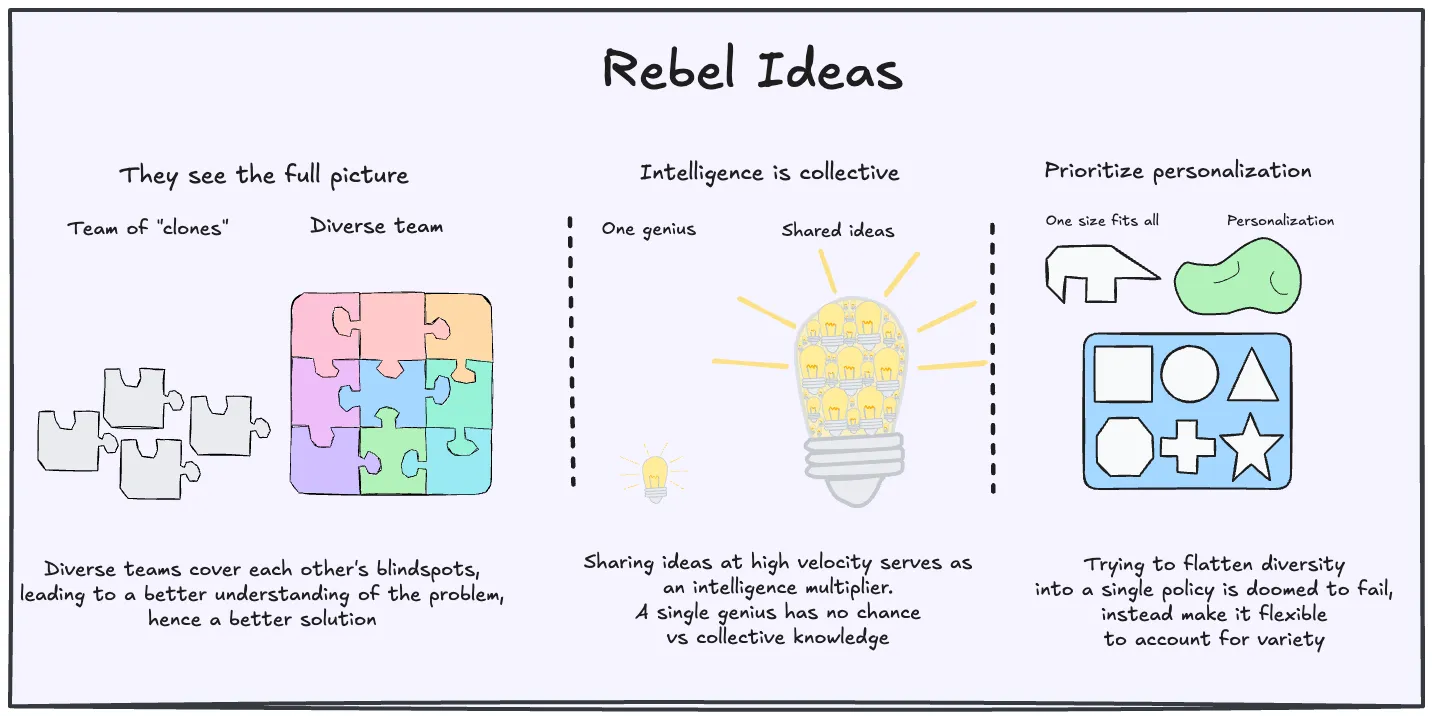
- Clones don't see the full picture - Each person is only capable of grasping a slice of the reality/problem, so a homogenous team of "clones" sees the same slices, which is unhelpful and misleading
- Quality and diversity go hand in hand - A diverse team is collectively seeing much more of the full picture, which makes it much more efficient in finding the right solution to the problem, and even identifying there's a problem in the first place. They cover each other's blindspots.
- Diversity needs room to speak up - Diversity is quickly shut down by hierarchy. Our innate desire to "fit in" and align with the leader's opinion is strong. In a hierarchical organization, where the leader's opinion is spoken first and is most important, there will be no diversity of opinions. It will be a clone factory. Only when given the space, security and expectation to speak up, diversity can be maintained.
- Insider vs outsider mindset - The more we are immersed in a topic, the more we get used to the status quo, seeing the world through a small lens - "if all you have is a hammer, every problem is a nail". Insiders can't see how the world is changing, and can't see their own blindspots. An outsider is free from these restricting views, and can suggest fresh new perspectives, be more flexible and critical with our thinking.
- Intelligence is collective - Intelligence at it's core is the speed in which ideas are shared. The faster they go, the smarter we are as a whole. Using knowledge that has been passed down through generations, together with shared ideas from the correct generation we create a "collective intelligence" that is greater than any genius person can achieve on their own. Each idea serves as a multiplier to another. Intelligence is an emergent property of knowledge networks.
- One size fits no one - Standardization polices tend to flatten diversity by create a "one size fits all", the problem with it is that flattening multi dimensional diversity into a single thing creates a false image of an "average person" that doesn't exist, so we get a policy that makes everyone worse off and fits no one. Instead, we should create dynamic policies built on personalization.
Relate
⛓ by following this method, what will happen? What is the goal of this book? You will realize the importance of diversity, from the personal level, to the organizational level, to the policy level. You will realize the importance of collective intelligence over individual brilliance.
Act
📋What should I do to achieve the goals set out by this book?
- Implement "leader speaks last" – ensure all team members share their perspectives before the person in authority speaks to avoid anchoring and silencing effects.
- Establish a shadow board – assemble a group of younger or junior employees to provide diverse viewpoints and challenge the perspectives of senior leadership.
- Commit through writing – require team members to write down their ideas or opinions individually before a group discussion to prevent them from assimilating into the group consensus.
- Use anonymous evaluations – judge ideas based on their merit alone by removing the identity of the person who suggested them to mitigate social bias.
- Practice "blind testing" in recruitment – evaluate candidates through skills-based assessments or anonymized resumes to avoid the unconscious bias of hiring "clones" who share your background.
- Inverse your thinking – identify the foundational beliefs of your business and imagine the opposite scenario to discover innovative "outsider" perspectives.
- Foster horizontal networks – participate in hackathons, online forums, and cross-company discussions to accelerate the velocity of information and combinatory innovation.
- Prioritize personalization over standardization – avoid "one size fits all" policies by allowing individuals to adjust their environment or workflows to fit their unique characteristics and needs.
- Recruit for cognitive range – select team members based on their different mental models and cultural backgrounds rather than just academic prestige or similar CVs.
- Adopt a giver's mindset – focus on collaborating and sharing knowledge freely to increase collective intelligence and the flow of information within your network.
Critique
🧩 relevant research, metaphors or examples that helps to convey the argument
- incremental vs combinatory innovation - incremental improvements are slow, small improvements from within, a slightly better version of the same thing. A combinatory improvement is when knowledge from different fields are merged together to a completely new solution, that's way ahead of current solutions.
- horizontal vs vertical networks - horizontal is when information moves across similar people within different contexts (imagine a hackathon), while vertical is when information moves between different people within the same organization.
- The CIA and 9/11 – Case study: The agency’s demographic homogeneity ("white, male, and western") caused them to misinterpret the threat of Al Qaeda as "primitive" rather than revolutionary. Supports: Homogenous groups suffer from shared blindspots which prevent them from understanding complex, multi-dimensional problems.
- The "Average" Cockpit – Historical example: Military flight cockpits designed based on "average" physical measurements fit no individual pilot correctly, leading to operational failures. Supports: Standardization and "one size fits all" policies fail because the "average" person is a statistical construct that does not exist in reality.
- Inverting Taxi Assumptions – Thought experiment: Taking the foundational belief of an industry ("a taxi service owns cars") and flipping it to create something new ("a carless taxi service"). Supports: Innovation is often achieved by "outsiders" who critically challenge and reverse established industry assumptions.
- The Enigma Code Team – Case study: The successful decryption effort required a specific blend of diverse expertise, such as psychologists and mathematicians. Supports: Diversity is only effective when it is relevant; collaboration is most synergistic when perspectives are germane to the problem at hand.
- Leader Speaks Last – Tactical device: A decision-making protocol where the highest-ranking individual reserves their opinion until the end. Supports: Mitigating the "silencing effect" of hierarchy to ensure diverse, true opinions are aired rather than suppressed.
- Blind Testing – Scientific method: Evaluating candidates or ideas behind a screen to remove identifying factors. Supports: Reducing unconscious bias allows for the selection of superior candidates and prevents the error of relying on similarity-based choices.
- Shadow Boards – Business practice: Organizations establishing a formal, consultative board of prominent, younger workers to advise leadership. Supports: Bridging gaps in collective intelligence by ensuring leaders remain connected to the perspectives of different generations.
- Luggage on Wheels – Product anecdote: A highly useful innovation that met initial cultural resistance because it was unfamiliar to the public. Supports: Innovation is not solely about creativity; it requires social adoption and must overcome the human preference for the familiar.
- Neurons and the Brain – Metaphor: Comparing individual humans to neurons within a larger, interconnected system. Supports: Collective intelligence is an emergent property of social interaction and shared ideas, rather than individual "hardware."
- The Puzzle Perspective – Metaphor: Viewing cultural and cognitive diversity as different pieces of a single puzzle. Supports: Seeing the "full picture" of reality is impossible from an individual vantage point; it requires the aggregation of different frames of reference.
❌ the logical jumps, holes or simply cases where it is wrong...
🧱 Implementations and limitations of it are...
Review
💭 my opinions on the book, the writers style... I was completely surprised by this book. I wasn't expecting anything special, and it was both captivating and enriching. Every chapter was like a whole new book, describing the importance and benefits of diversity from a different angle, while still staying connected to the overall theme of the book. It had no spare parts, from the stories to the content - really well done.
Outline
Notes
Collective Blindness
The modern world is filled with complex Problems, ones that are too much to handle for any individual. The only way to solve them is through shared, collective work. Intelligence that matters is an emergent property, it can only be understood when we Zooming out gains perspective through mental distance and look how humans interact and specifically share ideas, not just how one person operates.
The future is a future of teams Peer support enables collaborative growth through shared feedback and mutual learning.
Complex problems require creative solutions, which are built on diversity. We need people who think differently, having more of the same (homogeneity) isn't helpful. Same people who have the same viewpoint will also have the same blindspots Group Thinking.
Moreover, we are not even aware of our own blindspots, so we don't know what we're missing until someone points it out to us Attachment distorts how we see the things we cling to. This is called perspective blindness.
People from different cultures sees the world differently Subjective perception filters how we see external reality,which could be the key to solving hard problems. Like pieces of the puzzle, together you'll have a clear, full picture of reality Seeing reality without subjective bias reduces distortion.
The main example is Al Qaeda and 9/11. The CIA was so "white, male and western", that they failed to understand the severity of the threat, how Bin Laden's messages resonate deeply with the muslim people, and represent a revolution, not a "primitive caveman".
- If we are intent on tackling our most serious questions, from climate change to poverty, from curing diseases to designing new products, we need to work with people who think differently, not just accurately. (Location 160)
- Pretty much all the most challenging work today is undertaken in groups for a simple reason: problems are too complex for any one person to tackle alone. (Location 177)
- even in our most direct interaction with the world—the act of looking at it—there are systematic differences shaped by culture. (Location 223)
- “The more diverse the perspectives, the wider the range of potentially viable solutions a collection of problem-solvers can find.” (Location 264)
- We perceive and interpret the world through frames of reference, but we do not see the frames of reference themselves. This, in turn, means that we tend to underestimate the extent to which we can learn from people with different points of view. (Location 268)
- the danger with homogenous groups: they are more likely to form judgments that combine excessive confidence with grave error. (Location 330)
Rebels Vs Clones
A group of people of similar (cognitive) background are like a group of clones. They overlap in their areas of focus, missing the big picture as if they only posses the same pieces of the puzzle.
Group thinking also has a coercive effect. If there are clear Expectations shape wellbeing through the gap between desires and reality how to behave and what to think, backed up by power (and/or hierarchy), people will begin to assimilate into the group, erasing their diversity, turning into clones Psychological safety enables risk-taking and vulnerability without fear of retribution.
Instead, we need a team of rebels, those who challenge the norms and question the collective decision in order to (together) arrive at the truth. Constructive dissent improves collective decision-making
Diversity is so critical because Range is more impactful than Competence is developed through practice not innate talent. Having "the smartest people" in the same room is meaningless if they're all identical. A diverse team of second rate people would do better. For example, when making a Prediction, the wisdom of the crowd the law of large numbers often beats an intelligent estimation. That's because they capture more of the complexity of the problem by having different viewpoints, while also cancelling each others' Noise obscures truth with external interference and confusion signals.
When it comes to Ideation generates ideas through exploratory thinking freed from constraints, a diverse team also has an advantage because they create a larger pool of ideas Generating multiple alternatives simultaneously improves outcomes, not all would be great, but you're more likely to find a good one.
Companies however recruit based on talent in a way that symbolizes Biased inputs produce biased conclusions. They go with the "best schools" or "best CV" which is a recipe for recruiting clones, as they all went through the same training. Talent has Each additional unit provides progressively less value, while diversity is Repeated actions yield exponentially increasing returns over time.
Diversity has to be in the aspects that matter. The default to demographic diversity is only sometimes relevant. A white and a black libertarian economists are not a good representation of cognitive diversity. Additionally, it can't be diversity for diversity sake, it has to contribute somehow to the problems at hand. Bringing a psychologist and a mathematician together to solve the enigma code makes sense, since code is a mathematical machine designed and operated by humans, but having a skate boarder is hardly helpful. The enigma team was diverse in many ways, which is why it was successful.
- when smart people from a singular background are placed into a decision-making group, they become collectively blind. (Location 658)
- Groups have a built-in tendency to become clone-like. (Location 679)
- We need to address cognitive diversity before tackling our toughest challenges. It is only then that team deliberation can lead not to mirroring, but to enlightenment. (Location 693)
- To achieve group wisdom, you need wise individuals. But you also need individuals without the same blind spots. (Location 762)
- In any domain that requires an understanding of broad groups of people, demographic diversity is likely to prove vital. (Location 819)
- Diversity contributes to collective intelligence, then, but only when it is relevant. The key is to find people with perspectives that are both germane and synergistic. (Location 839)
- Diversity isn’t some optional add-on. It isn’t the icing on the cake. Rather, it is the basic ingredient of collective intelligence. (Location 846)
Constructive Dissent
A diverse team is meaningless if there's a clear and strict Hierarchy. We are "programmed" to follow the leader, which makes us hide confronting evidence, even if we know it's true and critical for the operations. For example in the past flight crew would rather risk death than confront the leading pilot.
Leaders, by their mere presence can have a silencing effect, causing their teams to adopt their view, faulty and limited as it may be. There's no surprise then that teams with more freedom to act perform well than teams with constant supervision by a high authority Micro-management restricts autonomy and inhibits growth.
Leadership has a One activity displaces another when pursued excessively effect. Especially if spoken first, it causes others to silence their true opinions and align themselves to the leader The first number sets the frame for all that follow. Instead of covering each other's blindspots, it amplifies them.
However, we can't work without hierarchy, otherwise chaos follows.
But, there's another form of leadership, one that's built on shared Respect. There, voices can be heard freely under the protection of psychological safety. The people know they won't be punished directly or otherwise for expressing their opinions Transparency requires actively revealing truth to others.
To further surpass our tendency to align with the leader, we can use these tactics:
- Leader speaks last - everyone else goes first
- Anonymous - to freely evaluate ideas without the bias of judging it based on the person who suggested it anonymous
- Commit through writing - if everyone first write down their ideas before presenting them, they can't "back down" or pretend they had a different opinion commitment
As times gets tough, we must resist the surrender ourselves to dominant forces, whether a charismatic leader or a higher power Surrendering agency to external forces destroys individual identity, because it's precisely these times where a dominant leader is more likely to make mistakes. The more complicated the problem, the more communication and diversity you need, not less. Complex problems require more diversity not less
- Useful information that never gets aired is not useful. (Location 1040)
- a team ethic, while precious, isn’t sufficient. No amount of commitment can drive effective decision making in a situation of complexity when diverse perspectives are suppressed—when (Location 1252)
- Groups typically need a leader, otherwise there is a risk of conflict and indecision. And yet the leader will make wise choices only if they gain access to the diverse views of the group. (Location 1331)
- People need to speak up, to offer rebel ideas, safe from the retribution of a leader who interprets such contributions as a threat. (Location 1404)
Innovation
It's not enough to be innovative, the society around you (or the company) has to go along with your idea. Innovation requires social adoption to create impact Like the person who invented luggage on wheels, some ideas are hard to swallow.
Culture can be a form of Past choices constrain future options and behavior, and usually the more brilliant your idea is, the less familiar it is which makes it harder to understand or accept.
Those who find it hardest to accept are usually the experts in the field, because they suffer the most from the Once learned, knowledge makes it impossible to imagine its absence. They are so entrenched in how their field looks now that they can't imagine it differently.
Innovation and diversity goes hand in hand. Ideas on their own are not that impactful, but when they are mixed with ideas from different fields, you can have extraordinary results Knowledge applied across contexts enables learning generalization. This is also called combinatory innovation, as opposed to incremental innovation which is a minor improvement over the existingOptimization finds the efficient point balancing outputs and inputs. The more diversity you have, the greater the chance for a successful "mating" between ideas.
That's why it's useful to be an outsider, because you have a different perspective on the situation, and the most to contribute. You have Flexability of thought. Being an outsider also makes you more likely to think critically as you are not bound by existing guidelines. Outsiders challenge assumptions that insiders cannot see To help you think like an outsider, try to Inverse your thinking, to take each foundational belief of your business/situation and see whether the opposite is possible. For example, "a taxi service owns cars", the inverse of that is "a carless taxi service", which is exactly what Uber is.
Ideas when shred have a Actions spread effects across people and time beyond initial cause, they become a Multiplier amplifies results through enhanced tools or behaviors that empowers innovation, as opposed to idea silos where their contribution is little to none. That's what makes intelligence a "collective" thing, we are smarter together Intelligence is an emergent property of knowledge networks. Ideas are as beneficial as their velocity through the Networks. That's why important discoveries were made almost simultaneously by different people because there peak periods of scientific knowledge sharing. Contrast that with cases of isolated communities which seems to fall behind technologically. The more we create chances to share ideas, for example places where workers from different companies can come and chat, hackathons, online discussion forums watercooler effect, the faster we spread information and the faster (and better) innovation we get. Low velocity is therefore a potential bottleneck for innovation. Similarly, we must differentiate between vertical networks (idea sharing within a company), to horizontal networks (idea sharing between companies). Horizontal networks are much stronger because the pool of potential ideas is much larger.
- The growth of the future will be catalyzed by those who can transcend the categories we impose on the world, who have the mental flexibility to bridge between domains, who see the walls that we construct between disciplines and thought silos and regard them not as immutable but movable, even breakable. (Location 1747)
- if you want to innovate in more profound ways, you have to step outside your existing framework. (Location 1762)
- Innovation is not just about creativity, it is also about connections. (Location 1976)
- Innovation is about breaking down walls. (Location 2004)
- the idea is to bring people away from their desks, to create areas where people feel encouraged to mingle, make chance encounters, and engage with outsider perspectives. (Location 2019)
Echo Chambers
Even when a large community/institution seems diverse, it can be very homogenous in practice. The reason is that given a large enough group, echo chambers are formed, as people have enough friends who are similar to them that you don't need to mix with others who are different Conformation bias makes us accept confirming evidence without scrutiny.
Paradoxically, a smaller group would have been more diverse because people would have been force to connect outside of their comfort zone. Small groups prevent comfortable retreat and force engagement
Meaning that as long as you have a way out, you will avoid doing the tough choices that are more beneficial. You must create an instance were there's No turning back.
The problem with echo chambers is that they're self reinforcing. Even if you encounter someone from the other side, you'll only be more entrenched in your beliefs, it will be a Debate treats disagreement as a zero-sum game, not a discussion. That's because within each chamber there's an attempt to dehumanize the other party, to discredit them, so even their arguments seems like a malicious intent.
When use ad hominem often, focusing on the person in front of us instead of the quality of their argument.
- “Echo chambers operate as a kind of social parasite on our vulnerability.… An information bubble is when you don’t hear people from the other side. An echo chamber is what happens when you don’t trust people from the other side.” (Location 2288)
- when people are denied access to diverse views and evidence, they are more likely to cleave to extremist beliefs and ideologies. (Location 2431)
Beyond Average
We mistakenly think that diversity moves on a single axis, yet it's a multi-dimensional variable. We mistakenly think it's a single dimensional variable that distributes normally where trying to appeal to the average would give us a "good enough" policy, yet we fail to notice that we fall pray to the missing average problem. There is no person that fits the average across all dimensions. It's like saying that the average person is an Indian, Christian person who speaks Chinese. It might not exist, and surely not common.
That's why standardization is a bad practice. We go with a "one size fits all" policy that fits no one and fails everyone. Neutrality is not an option. It also alianates people from it, since they don't see themselves in it or feel that it matches their preferences.
Instead, we should have the option of Personalization, the ability to adjust the situation to your unique characteristics. When people have control over important aspects of their lives they feel included, which increases their wellbeing and productivity.
examples - cockpits for pilots that used the "average" man measures across several aspects, which fitted no one (and caused accidents), or health experiments that found no effect, while in reality it affected some very positively, and some very negatively.
- averaging diverse predictions is a way of exploiting diversity. Standardizing the way people work, or learn, or whatever else, risks squashing diversity. (Location 2665)
- “Give people autonomy to create their own spaces, and they come up with something better than almost anything else you can give them,” (Location 2921)
The Big Picture
Our advantage as humans is not the size of our brain, it's even smaller comparative to our ancestors. Instead, it's our ability to socialize Communication is in our nature. To quickly learn from others, sharing knowledge that takes a lifetime to learn on your own Human is a social being.
By passing information from one generation to the next, ideas accumulate into a collective intelligence Thinking extends beyond the brain to environment and society. This allowed for the creation of technology such as fire and water bottles that allows us genetically to outsource "unnecessary" large systems such as digestion and transfer more energy to our hungry big brain. Communication between large groups and the ability of social learning is what separates us from other mammals, not our hardware social evolution. Our intelligence is an emergent property of humankind, each person is like a neuron in a larger brain.
How to increase our collective intelligence:
- Reduce unconscious bias - when two candidates are very similar, we tend to unconsciously favor candidates that are similar to us. By doing more "blind testing" like playing behind a screen can protect us from bias. The bias is not only unfair, we are worse off for it, choosing the lesser candidate. unconscious bias
- Shadow board - companies are often led by "old people", to stay connected to the younger generation they set up a "shadow board", full of prominent young workers that can share their opinions
- Be a giver - Collective intelligence requires collaborating. A "taker's" mindset is harmful, while a "giver's" empowers it. It improves the velocity of information flow. Providing value without expectation of return cultivates wellbeing
- a smart person—could learn more from the group than they could figure out in a lifetime on their own. (Location 2999)
- Stripped of the cumulative body of ideas, the naked human brain is far less impressive. (Location 3092)
- By bringing different insights together, by connecting within and across generations, by recombining rebel ideas, we have created breathtaking innovations. It is our sociality that drove our smartness, not the other way around. (Location 3126)
- The willingness to share, to offer knowledge and insight and creative ideas, pays huge dividends in a world of complexity. (Location 3232)
- people are considered loyal not when they agree, parrot, and validate, but when they honestly disagree, challenge, and diverge. (Location 3259)