Mattering (Book)
Note-Making
Clarify
🔈 Summary of main ideas
- Recognition - to see the effects of your contribution, that your actions mattered. It connects you to a larger goal, you feel like you belong.
- Reliance - You have something to contribute to the world, your skills, your hard earned lessons, your growth from trauma. All can be of service, you can be needed.
- Importance - You need to be someone's number one priority (sometimes), to get the gift of attention and time.
- Connection - everyone needs someone that cares for you, a partner or a mentor that makes sure you stand back up when you're down.
- Attunement - When you have someone who "gets you", it changes everything. You're being treated the way you'd like to. It's also reciprocal, by seeing others, you're more likely to get help in return.
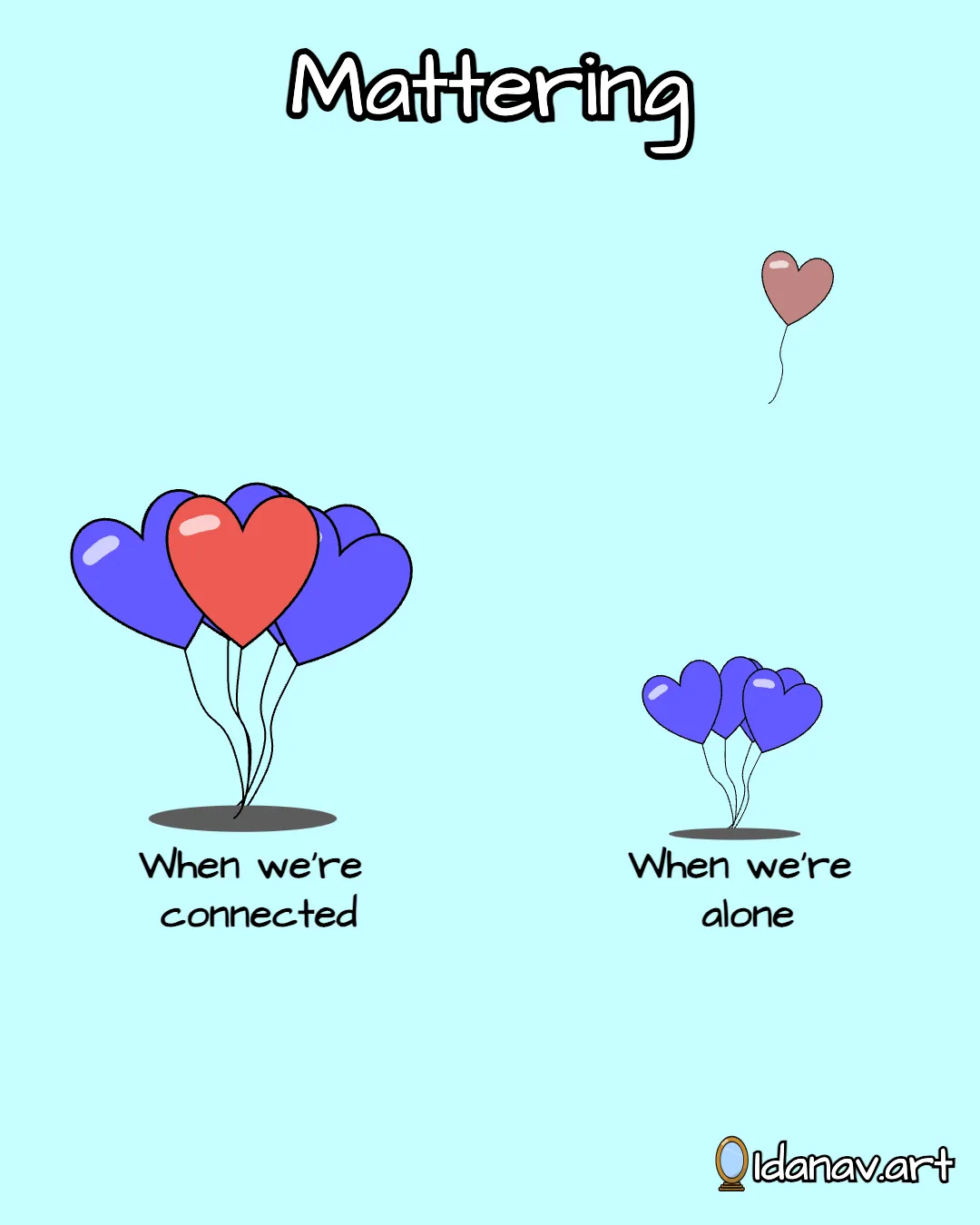
- When we matter, I matter - Mattering is all about connections, to our friends, family, community. We need to revive the shared spaces around us, to find connections and support where we are. The network we have is self rejuvenating. When we help others to matter, we matter as well.
- Every change is scary - No matter which change we are going through, whether positive or negative, it could shake our sense of mattering. After every big change we need to reevaluate our sources of mattering and make sure we maintain them or recreate them post change
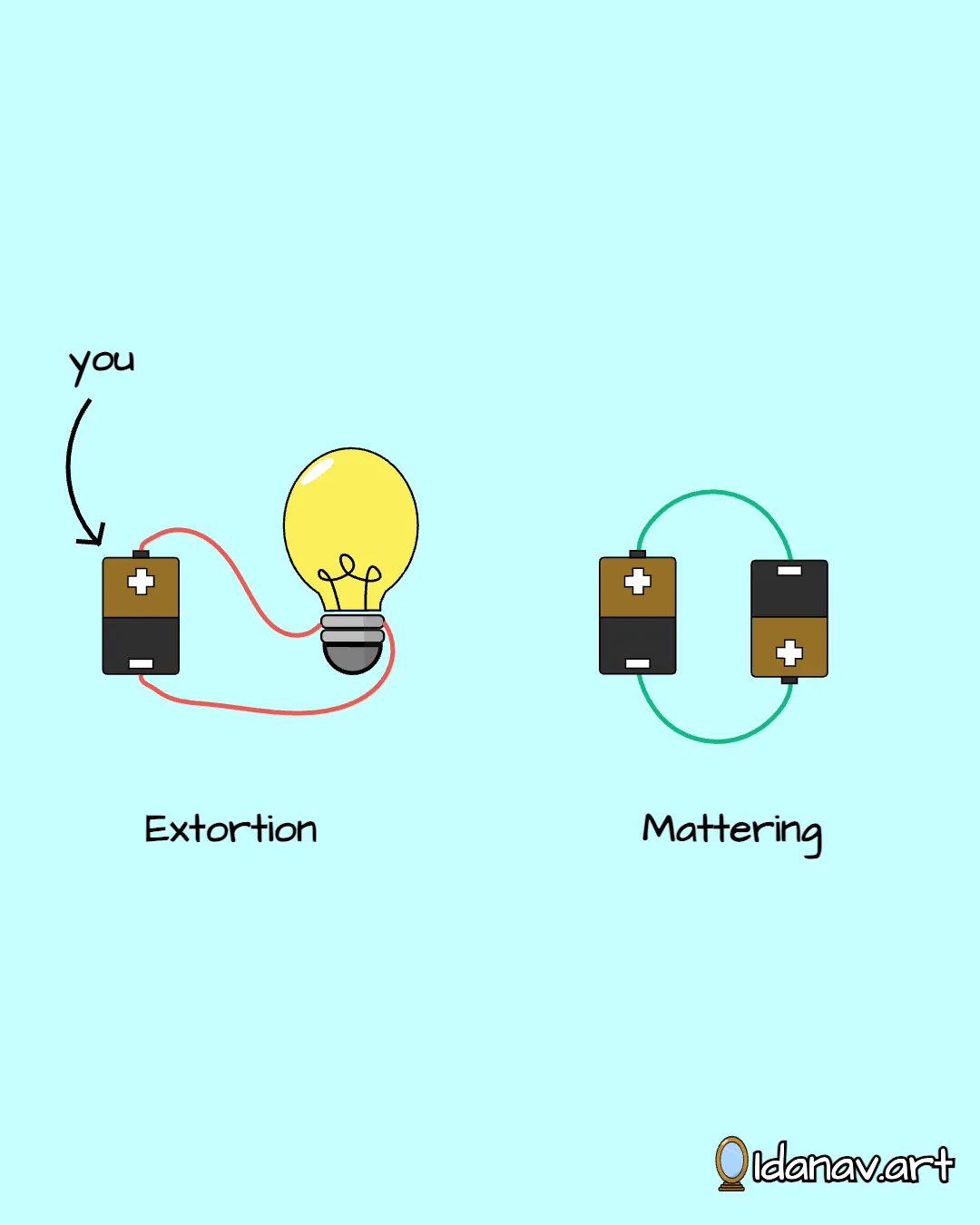
- Mattering is giving and receiving - To be a pure giver without nothing in return is not true mattering, it is extortion. Mattering means that we matter as well, not just what we do
Relate
⛓ by following this method, what will happen? What is the goal of this book?
Act
📋What should I do to achieve the goals set out by this book?
- Pass feedback along – investigate contributions and resurface their effects to make them visible and known.
- Create traditions of recognition – send company-wide appreciation emails or give tokens of gratitude.
- Praise the person – compliment the individual's character traits rather than just the specific deed.
- Ask for help – query others on what they need and what bugs them to find ways to be needed.
- Protect self-care time – find something you do for yourself and safeguard it by setting firm personal boundaries and rules.
- Find a cornerman – search for a mentor or caretaker in your workplace, family, or college to receive support and feedback.
- Broadcast your feelings – name what you feel and signal your need for help to increase the likelihood of others attuning to you.
- Eliminate dirty fuel – remove fear and external manipulation tactics from your interactions and leadership approach.
- Trust your workers – give up control, provide advancement opportunities, and support workers across all aspects of life.
- Create mattering spaces – invite people into shared spaces using food as a primer for connection and kindness.
Critique
🧩 relevant research, metaphors or examples that helps to convey the argument
- Gravity metaphor – Metaphor comparing mattering to gravity as an unseen, essential force that holds us in place and prevents us from drifting. Supports: The core human need for mattering.
- NASA janitor anecdote – Anecdote of a NASA janitor describing his role as helping put a man on the moon. Supports: Connecting daily tasks to a larger goal to generate personal meaning.
- Outsourced gestures – Case example of financial tools like Uber replacing home-cooked meals or airport rides. Supports: How outsourcing traditional acts of care strips away opportunities for human connection.
- Personal boundary rule – Personal rule example such as refusing to answer emails after seven. Supports: The necessity of setting rigid boundaries to prevent overloading and ensure self-prioritization.
- The beautiful mess effect – Psychological phenomenon showing that people are much more open toward those who expose their vulnerabilities and imperfections. Supports: Exposing vulnerability during life transitions to build authentic connection.
- Successful retirees' adaptation – Case observation of successful retirees maintaining optimism, relying on social networks, setting goals, and viewing setbacks as temporary. Supports: How to cope with major life transitions by leaning on support networks and maintaining direction.
- Dirty vs. clean fuel at work – Metaphor comparing fear and external motivation to "dirty fuel," and intrinsic motivation to "clean fuel." Supports: The superiority of intrinsic motivation and recognition over fear tactics in the workplace.
- Food as a social primer – Observation that sharing food serves as both a motivator for gathering and a primer for kindness and chattiness. Supports: Creating accessible "mattering spaces" to foster community connection.
- Astronaut lifeline cable – Metaphor describing a "matter core" as a cable that protects astronauts from drifting into space. Supports: How deep connections to the world protect individuals from burnout and depression.
- The extended hand – Anecdote regarding the limitation of fixing pain versus simply being an extended hand. Supports: The enduring positive ripple effects of small acts of kindness even when outcomes cannot be completely fixed.
❌ the logical jumps, holes or simply cases where it is wrong...
🧱 Implementations and limitations of it are...
Review
💭 my opinions on the book, the writers style... I wonder how much "mattering" differs from happiness or fulfillment, or all these concept describe the same thing.
Even within the different aspects of mattering the author described, there's a great overlap. For example what's the difference between reliance and recognition, exo extension and importance.
Also, majority of each chapter is why we lack mattering, and a story to illustrate, but low on content.
Outline
Notes
The Mattering Core
To matter means to feel that you are valued, while also actually contributing to something, an objective and subjective aspects Meaning combines personal connection with objective worth. The need to matter sits at our core, after basic survival needs, comes the need to matter.
Mattering is a double edged sword because when we have it we're Bursting with life, we're at our peak, the most happy.
When we don't we're at our lowest. Falling to either Burnout or Depression.
Without mattering, we might react in three ways:
- Indifference - we're detaching ourselves from the world, not caring about anything Indifference can be protective or harmful depending on its source
- Lashing out - we substitute positive mattering with negative one. Our "destiny" becomes one of destruction, our legacy is hurting others Misbehavior often seeks belonging not harm
- Imploding - we punish ourselves, consuming substances and neglecting ourselves self neglection is caused by lack of meaning
Those that feel like that matter often have a "matter core", something that connects them to the world, like a cable that protects astronauts from drifting.
The components of a "mattering core":
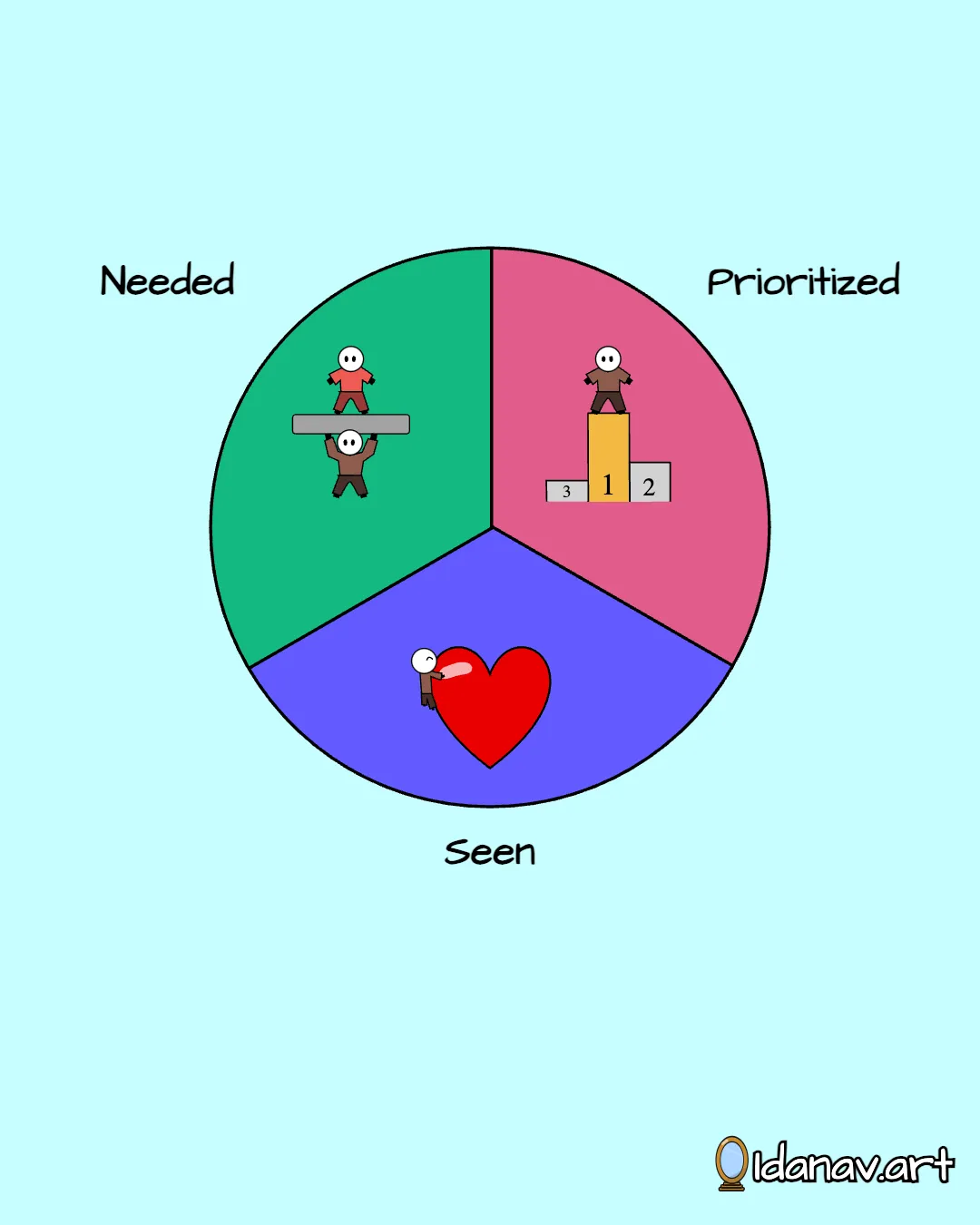
- Recognition - feeling valued, and your absence is felt
- Reliance - you feel needed, others depend on you
- Importance - feeling significant and prioritized
- Ego extension - others are invested in your well being
- Attunement - you feel understood and seen
- mattering is the feeling that we are valued and have value to add to the world. (Location 97) ^ref-18046
- Mattering is the assurance that our presence and actions are significant to others. (Location 99) ^ref-21561
- Mattering is so deeply ingrained in us that after basic survival needs like food and shelter are met, it is the need to matter that drives human behavior. (Location 116) ^ref-22880
- Mattering is double-edged—powerful when we feel it and destructive when we don’t. (Location 158) ^ref-21387
- Mattering is like gravity: unseen but essential. It holds us in place. It steadies us. When we feel that we matter, we feel anchored. When it’s missing, we begin to drift. (Location 175) ^ref-61200
- The Mattering Core Recognition: You and your actions are valued, and your absence would be felt. Reliance: You feel needed because others depend on you. Importance: You feel significant because you’re prioritized. Ego Extension: You feel cared for because others are invested in your well-being. Attunement: You feel deeply understood and meaningfully responded to. (Location 228) ^ref-27953
Connect to Your Impact
It's not enough to make a positive contribution, we also need to know that we contributed. Like giving donations without knowing whether it really helped save lives, even firefighters that save people from burning buildings but not knowing whether they survived afterwards can experience burnout.
Detachment between our contribution and it's effect can cause Alienation. While getting feedback, seeing or hearing that we actually helped is a great source of motivation.
To make the contribution more felt, more visible, as a leader your responsibility is to pass that feedback along. To investigate what was the contribution and resurface it back
Also you can create your own traditions of recognition, like sending a company wide email for appreciation of a worker, or giving a token of gratitude People First.
It's even more powerful when you praise the person and not just the deed. "You're a punctual, caring person" is better than "thank you for being on time" Praises can lead to fixation Praises
Getting recognized is a game changer. People starts becoming proud of their work, invest in their workplace and their coworkers recognition gives a motivational boost.
All it takes are small gestures of Practicing gratitude shifts perspective toward positive wellbeing, like giving thank you notes, or saying "if it weren't for you...". micro gestures have a huge impact on wellbeing
You can also "encourage" yourself by connecting to a larger goal, seeing how your task is part of a grather whole connecting to a larger goal brings meaning Finding meaning in work increases fulfillment and resilience, like the NASA janitor that said "I'm helping put a man on the moon"
Those small acts Ripple to much wider circles. The person you are kind to becomes kinder to others Kindness
- we need to know that our actions make a positive impact, (Location 307) ^ref-35714
- The deepest principle in Human Nature is the craving to be appreciated. (Location 342) ^ref-17483
- Recognition is a way of saying, I see the good in you. In moments like this, people remember who they are and why they matter. (Location 436) ^ref-63313
The Good Kind of Weight
Feeling needed is our tether to the world. To be completely detached, have complete freedom sounds tempting but it quickly leads to suffering detachment is suffering disgusted as freedom
When we're overwhelmed, the default is to take a step back, because we view energy as a scarce resource. However energy is more like a renewing resource, help others boosts us as well Helping others benefits the helper too.
You can multiply your "good feeling" of giving by combining it with your unique strength. Doing what you love to do for others is very satisfying.
Another option is to help in a field that you care about, that causes you pain. For example to be an environmental activist, or to pass on hard earned lessons you learned on your path, perhaps recovering from trauma Pain.
If you're still not sure how to be needed, ask them. Ask people what they need help with, what bugs them, and do what you can.
Every small act is meaningful, they all ripple onwards to many people. So follow the Golden rule, be kind by default, change the world one small act at a time.
- Instead of burning us out, turning outward can light us up by reminding us just how essential we are to others. (Location 550) ^ref-29697
- too much freedom without meaningful responsibility can leave us feeling hollow. (Location 557) ^ref-25917
- When we ask someone for advice, we affirm their value. (Location 625) ^ref-43405
- Every act of kindness, no matter how small, reflects a choice to see and value another person and creates ripples of goodness that we may never fully understand. (Location 732) ^ref-10061
- We don’t always get to fix the pain, change the outcome, or rewrite the story. But we can all be that extended hand. (Location 757) ^ref-33037
Mattering Too much
We sometimes give and give and get nothing in return. That's a distorted form of mattering. To truly matter, we have to also be prioritized, to be someone's number one, at least some of the time, to also get taken care of.
Recently this has been decreased for three main reasons:
- Overloading - as we now have more and more responsibilities, for example we have to be the perfect parents, perfect partners, perfect workers, there's hardly any time left to be taken care of Overloading
- Outsourcing - many of the things that used to be a sign of care, like getting home cooked meal or a drive to the airport are now Outsourced to "cold" financial tools such as uber, that robs us from the chance to connect
- Expectations - we're told that we should be glad that we have the opportunity to be a supportive parent, teacher, worker. We're expected to give without receiving Expectations
When we're last on everyone's list, we start to believe it, losing our feeling of self worth. We have to take care of ourselves first, so that we could take care of others Self-love and love of others are the same act put your oxygen mask first. Find something you do for yourself and protect it, because if you don't self prioritize, others won't. It also means to protect your boundaries, to set up "personal rules" such as "I don't answer email after seven" Rigid rules.
Putting yourself first is not a "self reliance" kind of thing. It's more in the form of finding someone to rely on. To be co-dependent. To find those that care for you and are willing to prioritize you. People are your oxygen mask Happiness is shared. On the flip side, being lonely is harmful for your mental health.
These are not "big asks", to be prioritized means to have a little bit of time for self care, or getting small gestures are micro moments of connection.
- In a world where almost everything can be outsourced, the things we choose not to outsource stand out. They become evidence of importance. The inconvenience is part of the gift. It’s what transforms a task into a message that says, You’re a priority to me. (Location 893) ^ref-27714
- When we feel last on everyone’s list, it’s easy to start seeing ourselves that way, too. We stop asking for help, defer our needs, and convince ourselves that self-sacrifice is noble. But mattering isn’t only about how others treat us; it’s also about how we treat ourselves. (Location 921) ^ref-62108
- Whatever your “thing” is, whatever act of radical self-prioritization allows you to keep showing up for the people who rely on you—do it. Because it does. (Location 960) ^ref-2784
- When we make each other a priority, we create the trust and space needed to show up as our real selves and know that we are worthy of support. (Location 969) ^ref-41349
- “real” connections lies not in the quantity of time spent together but in the deliberate intention to prioritize one another. (Location 999) ^ref-14428
Everyone Needs (To bE) a cOrnerman
You need a "cornerman", someone who supports and care for you. There are two types of cornerman (which can overlap):
- A caretaker - someone who stays by your side no matter what, that cares for you as if you were the same person Unity, a type of "ego extension" between the two of you
- A mentor - someone who can give you feedback as an external observer, that knows the path you need to walk, that has the expertise and helps you become better without self loading Mentor
Search for cornermen where you are, in your workplace, your family, your college. Be open for feedback and support.
If you can, be someone's cornerman, help others the way you want to be helped. Sharing their joy will also increases yours Mirror neurons.
- Our “cornermen” protect our sense of mattering by affirming who we are now and who we can be in the future. (Location 1350) ^ref-51286
- Healthy encouragement helps us grow without making us feel inadequate in the process. (Location 1364) ^ref-3380
Tuning in
Attunement is when we really "get" someone, we see the world through their eyes, meet them where they are Resonance. We all need to be understood, not just to be seen. Over time, to not be seen will cause us to feel not important, that our feelings are too much and we're unworthy of love Shame.
We can also avoid attunement due to the pull of modern technology, specifically the isolating factor of modern comfort. The pull to stay in and binge can be stronger than going out. Also social media can give "empty calories" of connection leaving us starving without knowing why Shallow copy social media is beneficial if it promotes face to face interaction.
The more we isolate ourselves, the more the Inertia kicks in until our social life erodes completely.
Even when we notice we need help, we don't always signal it to those around us. We should "broadcast" our feelings in order to increase the likelihood of others picking it up and attuning themselves to us Broadcasting your feelings invites attunement.
It starts with naming what we feel, this gives us higher control and understanding of it, and makes it less likely it will be released in an unhealthy way Emotional hijacking.
When you're attuned to others, you're also increasing the likelihood of others being attuned as well. It's a reciprical process Attunement is reciprocal. When you're kind to others, they are more likely to be kind back.
Attunement doesn't mean agreement, you can be kind to someone even if you don't agree with them Attunement does not require agreement
- Attunement allows you to respond to the nuances of a moment and ensures that your efforts to make someone feel valued actually land in a way that feels right to them. It is the difference between seeing someone and seeking to understand them. (Location 1587) ^ref-35931
- it is the capacity to be in sync with another person’s inner world. (Location 1600) ^ref-46404
- Over time, repeated experiences of misattunement can lead children to internalize shame, forming the belief that their emotions are too much, or worse, that maybe they are somehow unworthy of love and connection. (Location 1616) ^ref-56788
- These cues—tone of voice, facial expressions, and body language—are how we read someone’s inner landscape. (Location 1628) ^ref-2361
- reaching out requires effort and resistance against the currents of modern life. But the reward is something no screen can offer. (Location 1667) ^ref-34546
- attunement doesn’t hinge on agreement. It rests on the willingness to pay generous attention and to see the person in front of you, even when you don’t see the world the same way. (Location 1817) ^ref-55592
When the Rug Gets Pulled: Coping with Life's Transitions
Life is never fixed Life is change, and every change is a form of "lifequack", when our perception of self, of our lives, and our sense of mattering is in danger Identity Discovery. This is true even when these are "good" or planned changes such as getting married, moving to college.
Our sense of mattering is not in a vacuum, it is tied to where we are and who we are with Interpersonal Identity, so when those change, we can suddenly feel as if we don't matter anymore. Just remember - you are not alone.
To understand how to recover your sense of mattering, it's time for a little "me-search" Self Reflection. By knowing which aspect of mattering was hurt during the transition, it will be easier for us to choose tailored steps to recover it and potentially reinvent ourselves.
Since others are an inherent part of our journey, don't be afraid to invite them to join you, either be their partner or role model on your way of recovering mattering. You don't have to be perfect, remember the "beautiful mess effect", people are much more open towards those that expose their "imperfections", their vulnerability Vulnerability
- You can’t build back someone’s sense of mattering for them. What you can do is stay close. You can listen, pay attention, and offer steady reminders that they’re still needed. (Location 1937) ^ref-41445
- By pinpointing which facet of our mattering has been disrupted, we can name the deeper need at the root and more thoughtfully consider what will help us rebuild. (Location 1959) ^ref-39776
- These successful retirees accepted that change is a natural part of life. They maintained an optimistic attitude and relied on social support networks such as friends, family, or colleagues to get them through this transition. They set goals to help maintain motivation and a sense of direction. They also all seemed to recognize that setbacks were temporary and did not define them. (Location 2006) ^ref-58124
How We Spend Our Days: Mattering at Work
How we spend our days is how we spend our lives, so since work is such a big part of it, feeling like you matter there is essential.
Nowadays the burnout epidemic is on the rise, most people don't feel like they matter because they don't feel appreciated, heard or respected.
Getting discriminated, dismissed or yelled at only causes us to either Reactance or ruminate over what happened, focusing us on the problem rather than the task at hand, increasing chances of error and lowering productivity.
Mattering at work is a good business practice to say the least, because workers who feel like they matter are more motivated and hard working.
Some workplaces use External Motivation and fear tactics, aka "dirty fuel" to motivate also it just escalates the burnout sensation.
Good workplaces use Intrinsic Motivation, aka "clean fuel" to motivate their workers.
It's not enough to use clean fuel, we also have to get rid of the bad one Crowding Out.
Show people that they matter, that what they do contribute. Small yet specific gestures (don't just say "thank you", say how their contribution helped)
Another way of empowering your workers is to Trust them, it does mean to give up control, but you gain much more in return. Give your workers advancement opportunities, support them in all aspects of life. Believe in them. Like how people quit bad managers, they stay for good leaders People are the most valuable organizational resource.
- when employees know they matter, they work harder, stay more loyal, and bring more passion to their roles. (Location 2262) ^ref-22821
Be an Architect: Mattering Spaces
Mattering is not done in a vacuum. The spaces we share affect our sense of mattering Third places anchor community connection.
Third places are on the decline, which means we have less and less spaces where we connect, chat, and meet others.
Everywhere can be a "mattering space", a bar, a restaurant, your back yard. You hardly need an excuse, just invite people in and let the connection happen. Food is a good motivator, both as a reason for people to come, and as a primer for kindness and chattiness during the event Food is a primer for connection and kindness.
You just have to meet people where they are. These third places are not just a place to connect, it's also a chance to go deeper, specifically to help improve the community's mental health. Bartenders, barbers, everyone can learn the basics of mental health signs, and be a pillar of support for their community.
The Power of "We mAtter"
Since we're all co-dependent, the best way to strengthen our sense of mattering is to make others feel like they matter. We support each other.
- By building up each other’s sense of mattering, we secure our own. (Location 2894) ^ref-31693
- No matter what kind of upheaval we’re facing, be it job loss, retirement, empty nesting, a shifting world, or some other destabilizing event, the surest way to sustain our own sense of mattering is to focus on making others feel like they matter. The shift from “I matter” to “we matter” gives us both the long-term resilience and legacy we crave. (Location 2899) ^ref-37895