Grit (Book)
✒️ Note-Making
Connect
Clarify
🔈 Summary of main ideas
- Grit is a productivity multiplier - Grit affects us in two ways. It improves our learning capabilities, which means we're better at improving our skills, and it makes us better at applying the skills, i.e we do it for longer periods of time, which means in overall we produce more. That's why grit matters more than talent. Talent is static, grit evolves us.
- The illusion of talent - even though it is much less valuable than talent, we believe talent explains success because it's a captivating magical story, that gives us excuses for not trying harder.
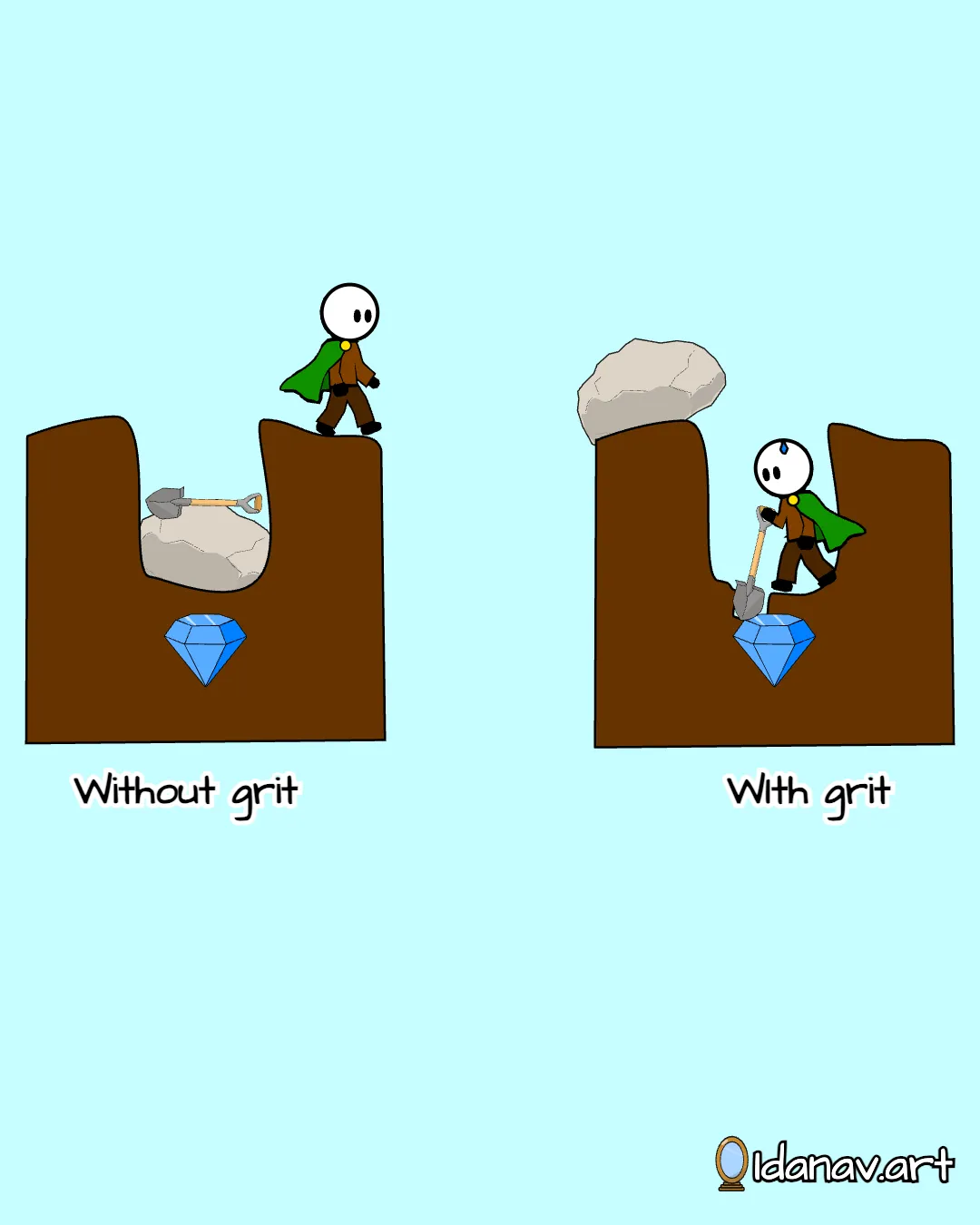
- Grit is about getting back up - No matter what we want to do, there will be struggles, we will fall down. Grit gives us the power to get back up. It is a force of internal motivation, fueled by passion.
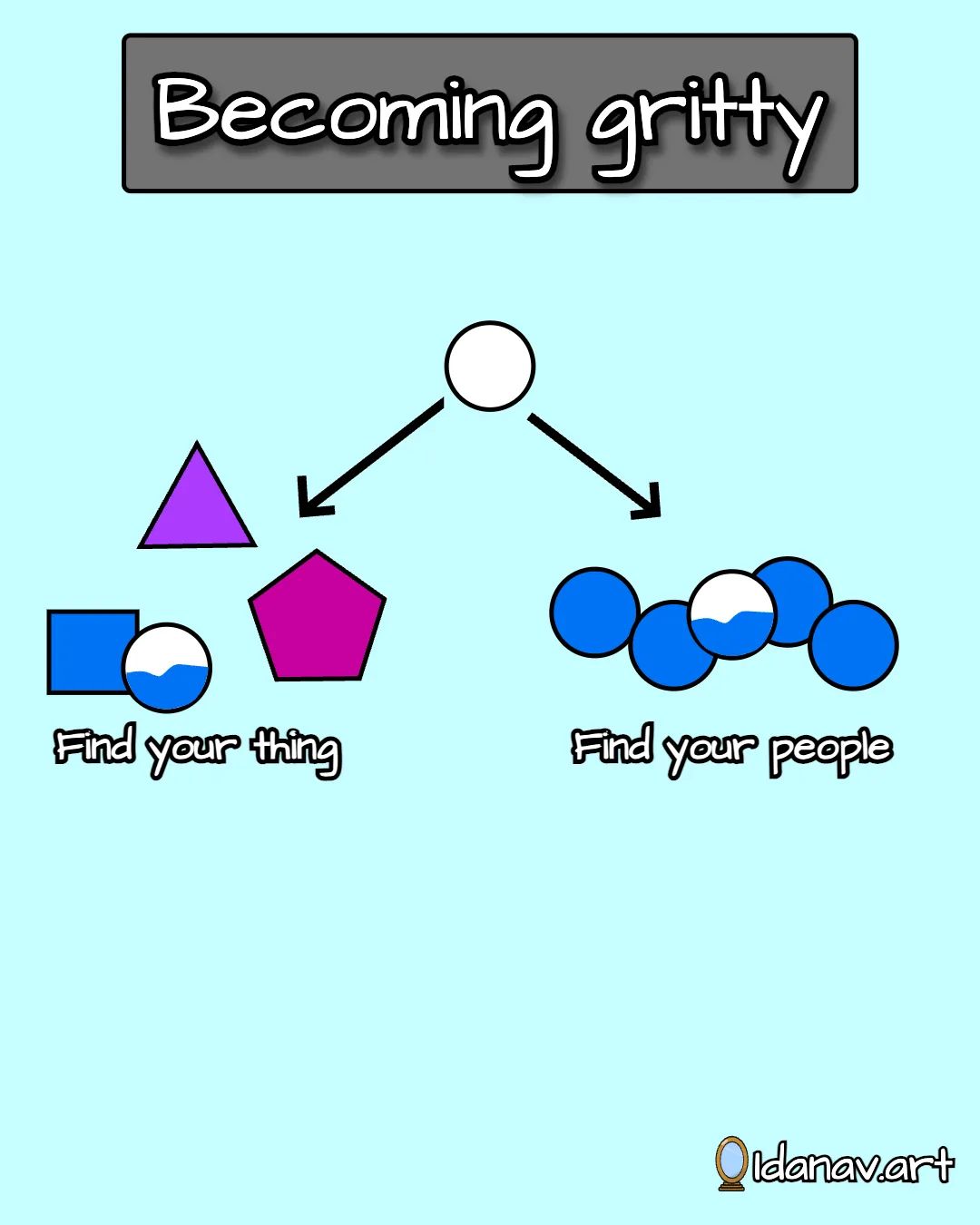
- Explore before you lock it - Grit for the sake of grit is worthless. It won't stick unless you find something that you think worths the effort and pain. So start with following your curiosity, see what's resonate, quit a thousand times, until you find the thing you'll never quit.
- Grit can be gained - Grit is (mostly) not genetic. It is a product of culture. So surround yourself with gritty people to become more gritty.
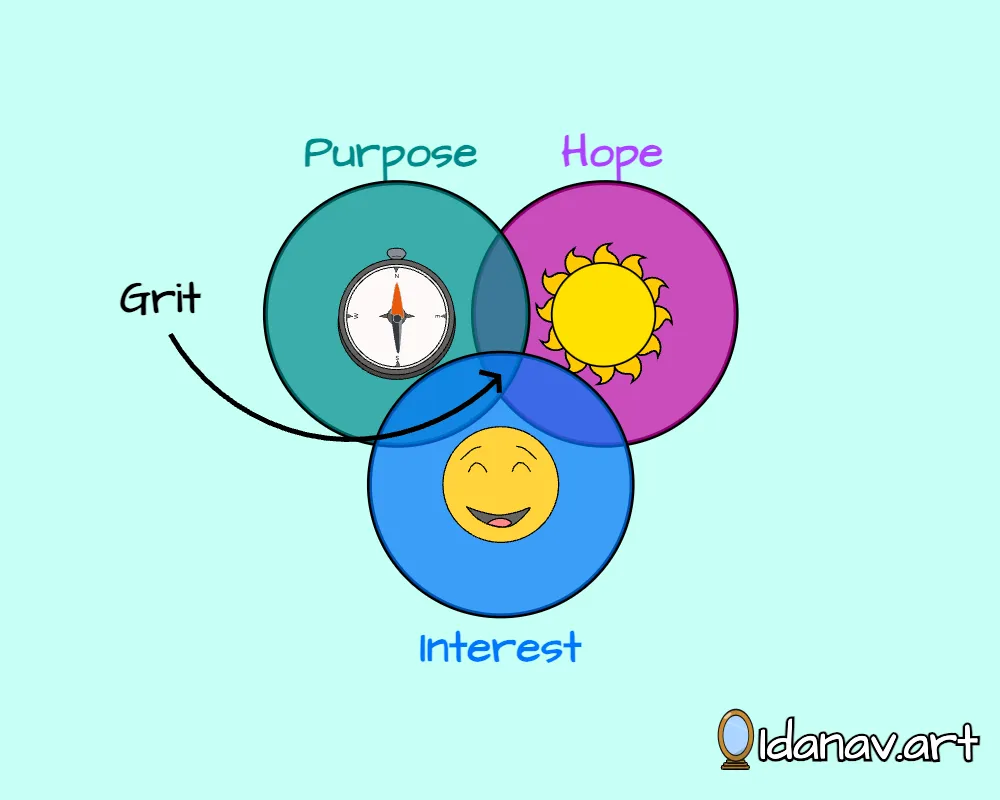
- What is grit - a combination of purpose (both internal and connection to others), interest (something that lights a spark), and hope (a strong belief that you can do better).
Relate
⛓ by following this method, what will happen? What is the goal of this book? You will become more gritty, able to better pursue your goals and achieve them, improving your skills drastically.
Act
📋What should I do to achieve the goals set out by this book?
- Align job with interests – match your job to what captures your attention and curiosity to empower productivity and reduce the likelihood of quitting.
- Explore before committing – use play and exploration to spark your curiosity before diving deep into an interest.
- Engage in deliberate practice – conduct relentless, hard practice aimed at your weaknesses, gather feedback with a specific goal in mind, and push beyond your comfort zone.
- Habitualize practice – create rituals and habitualize your deliberate practice to bypass overthinking.
- Find your purpose – use patience and exploration to discover work that feels meaningful and helps others.
- Adopt a growth mindset – focus on how to become better when you fail and maintain an optimistic, future-oriented thought process.
- Practice wise parenting – combine high expectations with strong emotional support and listening when helping children pursue their interests.
- Commit to extracurriculars – persist in a class or extracurricular activity for at least a year to positively affect your personality.
- Follow the hard rule – allow quitting only at a natural break point like the end of the year, never on the first hard day, while letting individuals pick their own difficult pursuits.
- Surround yourself with gritty people – use the power of your social environment by spending time with gritty individuals to shape your own behavior and culture.
Critique
🧩 relevant research, metaphors or examples that helps to convey the argument
- West Point "Beast" Training – Case study tracking candidates who drop out during intense military training despite high qualifications. Supports: Grit is a better predictor of retention and success than raw talent or SAT scores.
- Effort Multiplier Equation – Metaphor explaining that effort builds skill and simultaneously makes skill productive. Supports: Effort counts twice and is more impactful than raw talent.
- The Four Psychological Assets – Scientific finding outlining interest, practice, purpose, and hope as developable components rather than fixed traits. Supports: Grit can be grown from the inside out.
- Discovery Followed by Deepening – Metaphor describing passion as initial exploration followed by lifelong development. Supports: Developing a passion takes time and patience rather than instant finding.
- Deliberate Practice vs. Flow – Scientific distinction noting that deliberate practice is used for preparation and stretching weaknesses, while flow is experienced during performance within comfort zones. Supports: Qualitative practice requires targeted, hard effort rather than just time on task.
- Suffering and Control – Psychological observation that hopelessness stems from uncontrollable suffering rather than the suffering itself. Supports: Having a sense of agency and control is vital for maintaining hope.
- The Parenting Matrix – Case study categorization of parenting styles based on support and demands. Supports: Cultivating parenting—holding high expectations while remaining supportive—best fosters grit.
- Extracurricular Persistence Rule – Anecdote/Observation about children participating in structured activities for at least one to two years. Supports: Extracurricular commitments teach that rewards require effort and help build passion and perseverance.
- Cultural Environment Imitation – Social observation that individuals naturally conform to the behaviors and norms of the groups they spend time with. Supports: Surrounding oneself with gritty people helps build and maintain a culture of grit.
- The "Hard Thing" Rule – Case study guideline requiring family members to pursue a difficult extracurricular activity of their choice while prohibiting quitting on a hard day. Supports: Developing grit requires enduring struggles while maintaining personal autonomy in direction.
❌ the logical jumps, holes or simply cases where it is wrong...
🧱 Implementations and limitations of it are... Despite the disclaimers throughout the book, still the main message is "it's good for you to learn to stick to things, so do it". Quitting is allowed while pursuing your curiosity, but once that step is over, you're expected to keep on no matter what. As if we never change, learn or grow, letting our passion change with us.
🗨️Review
💭 my opinions on the book, the writers style...
This book got a lot of love but also a lot of hate. I think that it was misjudged because people focused on the grit part, but the writer does much more to explain when grit is useful and when it is not, how we cultivate it, and not just let it blindly push us towards something that we do. it must align with purpose, curiosity, values. It is better than I thought it would be.
Outline
Notes
Preface
Grit matters more than talent Practice beats talent
- I won’t just have a job; I’ll have a calling. I’ll challenge myself every day. When I get knocked down, I’ll get back up. I may not be the smartest person in the room, but I’ll strive to be the grittiest.” (Location 47)
What Grit it and why it Matters
Showing up
People work very hard to get to West point, only to drop after two months during the brutal "Beast" training. What predicted who stays and who quits? not raw talent, not sat scores, it's who has more grit. Grit is an enduring passion, a strong motivational force that allows you to keep going forward despite obstacles, almost an addiction to push on. Passion.
Grit doesn't just gives us the motivation to continue on, it also makes us better. Those with more grit are those who train more and harder, which causes them to improve. That's why grit matters more than raw talent.
- it was the chase—as much as the capture—that was gratifying. Even if some of the things they had to do were boring, or frustrating, or even painful, they wouldn’t dream of giving up. Their passion was enduring. (Location 145)
- Our potential is one thing. What we do with it is quite another. (Location 235)
Distracted by Talent
Those with grit have a hunger to learn and improve Growth Mindset. They strive to become better. When they fail, they focus on how to become better Forward thinking
We are obsessed with talent, with getting "the smartest and the brightest", which causes us to miss other (more) important factors such as grit.
- By shining our spotlight on talent, we risk leaving everything else in the shadows. We inadvertently send the message that these other factors—including grit—don’t matter as much as they really do. (Location 477)
Effort Counts Twice
By focusing on talent, we mistakenly equate talent to success. We see the world as binary, either you have "it" or you don't. Either you're talented or not. Talent has a magical appeal to it, we see talent as this raw magic, some elusive property that gives you the wining edge. We like to believe that because it's a convenient coping mechanism, because if we can justify why they are special due to some mystical innate property, this gives a perfectly good explanation why we can't achieve what they have achieved. It justifies the status quo.
Efforts is more important than talent, because it counts twice. It makes us better at the skill, and it is relevant when applying the skills, meaning it makes us more productive Multiplier.
So achievements is not about how fast you're running, it's about staying on the path and get back up when you fall Consistency
- Talent is how quickly your skills improve when you invest effort. Achievement is what happens when you take your acquired skills and use them. (Location 620)
- Talent—how fast we improve in skill—absolutely matters. But effort factors into the calculations twice, not once. Effort builds skill. At the very same time, effort makes skill productive. (Location 624)
- Many of us, it seems, quit what we start far too early and far too often. Even more than the effort a gritty person puts in on a single day, what matters is that they wake up the next day, and the next, ready to get on that treadmill and keep going. (Location 739)
- Without effort, your talent is nothing more than your unmet potential. (Location 748)
How Gritty Are You
Grit is expressed through the number and types of goals have. Having a few "major goals" and a variety of "sub goals" that would help you get there is ideal. The structure shows the resilience of gritty people, when a sub goal fails, there are others to take it's place, maintaining progress towards your goals Reserves.
- Enthusiasm is common. Endurance is rare. (Location 900)
Grit Grows
Is grit something that's genetically determined or not? Nature vs nurture.
The short answer that it's genetically determined to an extent. The long answer is that it's culturally affected. It's like how people are getting smarter between generations, it's not that our genes change that much, but it's how they're expressed/utilized that changes Cultural evolution is faster than biological evolution. For example, if we spend more of our time in philosophizing rather than basic survival, than overall we will be smarter.
Another factor is our age. We become grittier as we mature. This is because we face harder and harder struggles that forces us to change Obstacles as stepping stones. We change because we have to, the obstacle is the catalyst for change.
The main components of grit:
- A deep interest in something
- an appetite for challenge
- a sense of purpose
- a hope that no obstacle can break
- Either small environmental differences, or genetic ones, can trigger a virtuous cycle. Either way, the effects are multiplied socially, through culture, because each of us enriches the environment of all of us. (Location 1272)
- Over time, we learn life lessons we don’t forget, and we adapt in response to the growing demands of our circumstances. Eventually, new ways of thinking and acting become habitual. (Location 1332)
- The four psychological assets of interest, practice, purpose, and hope are not You have it or you don’t commodities. You can learn to discover, develop, and deepen your interests. You can acquire the habit of discipline. You can cultivate a sense of purpose and meaning. And you can teach yourself to hope. You can grow your grit from the inside out. (Location 1379)
Growing Grit from the inside out
Interest
Match your job to what captures your attention and curiosity. It will empower both you and your productivity. You are much less likely to quit if you're doing something you enjoy. When they both align, you suddenly feel like you're exactly where you belong Bursting with life.
You can't discover your interest from just thinking about it, and usually it's not found intentionally. It's often the result of Play. Before you get gritty and deep dive into something, you explore and see what sparks your curiosity. This also means that you need the freedom and the emotional support to do so Safe Base.
We always seek novelty. When we're novices, that novelty means a new area to explore. When we're experts, novelty becomes nuance, the small details experts notice smaller detail.
Developing a passion takes time and Patience. It's not about finding "the answer", just picking "a answer" and explore it.
- passion for your work is a little bit of discovery, followed by a lot of development, and then a lifetime of deepening. (Location 1516)
- Before hard work comes play. Before those who’ve yet to fix on a passion are ready to spend hours a day diligently honing skills, they must goof around, triggering and retriggering interest. (Location 1561)
- At the start of an endeavor, we need encouragement and freedom to figure out what we enjoy. We need small wins. We need applause. (Location 1584)
- You don’t have to find the “right” one, or even the “best” one—just a direction that feels good. It can also be difficult to know if something will be a good fit until you try it for a while. (Location 1693)
Practice
Improvement requires practice, but not just any practice. It's not just the amount of time you spend on a task that improves you, it's also the quality. It starts with motivation, having Internal motivation, also known as kaisen in Japanese, a desire to continue to improve despite hitting a plateau, because the more you improve, the harder it is to improve Diminishing Returns.
The key for qualitative practice is Deliberate Practice. It's a relentless, hard practice aimed at your weaknesses, gathering feedback with a specific goal in mind. Pushing beyond your comfort zone.
The advantage of regular deliberate practice is that with time the task itself can create a sense of Flow when you're returning to practice within your comfort zone. Experts don't necessarily enjoy the training itself, especially when it is brutal, but they enjoy the results of their training, to see the fruits of their labor.
So what separates the great from the rest is that they're able to habitualize their deliberate practice. They all have their Rituals.
- grit is not just about quantity of time devoted to interests, but also quality of time. Not just more time on task, but also better time on task. (Location 1728)
- deliberate practice is for preparation, and flow is for performance. (Location 1924)
- Nobody wants to show you the hours and hours of becoming. They’d rather show the highlight of what they’ve become. (Location 1963)
- Each of the basic requirements of deliberate practice is unremarkable: A clearly defined stretch goal Full concentration and effort Immediate and informative feedback Repetition with reflection and refinement (Location 2002)
Purpose
Interest is important, but what really sustains our motivation is a sense of purpose, to feel that what we do matters, especially matters to others.
Purpose is highly related to our work because that's a big chunk of our time. It doesn't really matter what you do, in many jobs you can find your purpose Job crafting.
Like interest, you won't always find your purpose immediately. It takes patience and exploration to find it.
Purpose is strongest when it's combined with interest, when what we love to do matches what we want to do, when we grow as we help others Meaning combines personal connection with objective worth.
- while interest is crucial to sustaining passion over the long-term, so, too, is the desire to connect with and help others. (Location 2158)
Hope
"Whether you think you can or think you can't, you are right". Being an optimist is life saving, in terms of happiness and success. Because being an optimist gives us flexability of thought, and turns us into Future oriented thinkers. We believe we can do something about it, so we're much more likely to do it and improve the situation Self fulfilling prophecy. As opposed to pessimists that are much more likely to suffer from depression and become Helpless.
It's all about having a growth mindset over a fixed mindset. The main reason why we probably develop one mindset over the other is whether we felt that we have a degree of control what happened to us, whether we felt that we could overcome. If we felt helpless, we stayed helpless. If there was a way out, we got back up.
Also, you don't have to get back up alone. Consolers, friends, mentors, they are all there to give us clarity and direction when we need to.
- it isn’t suffering that leads to hopelessness. It’s suffering you think you can’t control. (Location 2475)
- When you keep searching for ways to change your situation for the better, you stand a chance of finding them. (Location 2561)
- when you have setbacks and failures, you can’t overreact to them. You need to step back, analyze them, and learn from them. (Location 2699)
Growing Grit from the outside in
Parenting for Grit
What is better for growing grit? Is it tough strict parenting that don't let out kids quit or give up? Or is it more gentle supportive parenting that lets them explore their own curiosities?
These are not mutually exclusive . The actual matrix is:
- Non supportive, non demanding - neglectful parenting
- Supportive, non demanding - permissive parenting
- Non supportive, demanding - authoritative parenting
- Supportive, demeaning - cultivating parenting
Cultivating parenting (in the book "wise parenting") is when we help our kids pursue their interests. To have high expectations but also be there for them, to listen, to assist when needed. To hold both ends at the same time, saying "I have high expectations but I know you can reach them".
Our actions carry much more power than our words. Usually gritty kids have gritty parents, because we serve as their Role Models. When we're there for them in times of need, when we show them how much we care and support.
- Children carry within them the seeds of their own future. Their own interests will emerge if we trust them.” (Location 2974)
- there’s no either/or trade-off between supportive parenting and demanding parenting. (Location 3008)
- what matters more than the messages parents aim to deliver are the messages their children receive. (Location 3034)
The Playing Fields of Grit
Extracurricular activities can help develop grit in kids. That's because they combine interest and challenge. The interest serves as the source of motivation, and the challenge helps them develop perseverance.
It's better not to over schedule their lives, even though we're likely under scheduling them.
If they can persist in a class for a year (preferably two), their personality will be positively affected.to reap the benefits.
What extra-curicular teach kids is that No pain no gain. That rewards require effort, that anything good in life is hard, or comes with a price.
It's okay for them to quit, as long as it's in a natural break point like end of year. It can't be on the first hard day. They should have something hard in their life, but they get to pick. They can switch multiple classes until the find the right one, the one that's worth the effort.
- extracurricular activities are a way for young people to practice, and therefore develop passion and perseverance for long-term goals. (Location 3329)
A Culture of Grit
If you want to be gritty, surround yourself by gritty people be a small fish in a large pond. Let's use the power of Social Environment in our favor. We tend to become similar to the people we are spending our time with. That's how places like the army, the workplace, sports teams and even nations can create a culture of grit.
Developing culture and especially grit takes time, but the results can be incredible.
Leaders have a very important role, they have to be out front, to lead by example, to lead with respect and care instead of fear. Like parenting, to set a high bar, while helping you get there.
- the calculated costs and benefits of passion and perseverance don’t always add up, at least in the short run. It’s often more “sensible” to give up and move on. It can be years or more before grit’s dividends pay off. (Location 3576)
- thinking of yourself as someone who is able to overcome tremendous adversity often leads to behavior that confirms that self-conception. (Location 3607)
Conclusion
Grit is a desired virtue, you can't have "too much grit". It is a keystone virtue, one that allows the fulfillment of others. It's not the only or most important thing in life, but it is worth it. Even if we are not talented, even if we will never be great. Grit allows us to fall and rise again each time.
- you can grow your grit “from the inside out”: You can cultivate your interests. You can develop a habit of daily challenge-exceeding-skill practice. You can connect your work to a purpose beyond yourself. And you can learn to hope when all seems lost. (Location 3856)
- finishing whatever you begin without exception is a good way to miss opportunities to start different, possibly better, things. (Location 3894)