The ways we label the world actually change how we perceive it. If our vocabulary is limited, our internal map of reality often misses important nuances, much like a two-dimensional drawing of a mountain. How can expanding our language help us see details that were previously invisible to our own minds?
Thinking in Words
Words are more than a tool for describing reality, they are the lenses through which we see reality.
"The limits of my language mean the limits of my world" said Wittgenstein which focused most of his philosophical life researching just how powerful this sentence is.
Ever wondered why the Inuit tribe has 50 words to describe snow?
It's not because they like snow, or because they have nothing to do all day but to stare at it. It's because these words serve a purpose, a distinction to them that's important to make. For them, the difference between thin or thick ice is a matter of life or death. It's not just a rich vocabulary, these words help them see the world differently, helps them survive.
Words are not just containers for meaning, they shape our thoughts. We can't think without words, even when we think to ourselves, we use the same language we read, talk, and hear with.
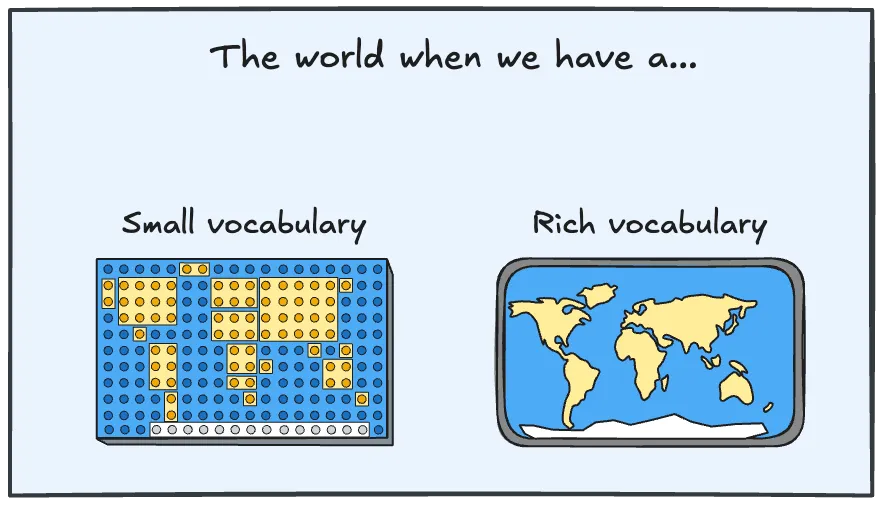
Language is how we construct reality, and words are the LEGO pieces. Heidegger would have greatly supported this claim, if only he knew what lego is - "Language is the house of Being. In its home man dwells."
Words as Reality's Building Blocks
The fewer words we have for something, the less likely we are to perceive nuances in it. Whorf, a famous linguistic described it beautifully - "We dissect nature along lines laid down by our native language. The categories and types that we isolate from the world of phenomena we do not find there because they stare every observer in the face." Meaning that the words we use are like contact lenses, we see the world through them, but we can't "see" the words themselves and how they shape (or distort) or reality.
For example, in Russian there are two different words for light blue and dark blue, which makes them better at detecting shades of blue than English speakers. The color in front of both is the same, but the mind sees something different.
Similarly, the labels we have for objects shape how we perceive them. Many languages have a gender for objects, so when the moon is considered "feminine", we say it's beautiful, clean, astonishing. When it's "masculine" we say it's big and strong. The moon stays the same, but our internal reality changes.
This means that when our language is narrow, it's like looking at the world through a black and white filter. Our internal reality is narrow and simplistic. However, the more we learn, specifically when we open our minds to new points of view, new languages, new ideas, we don't just increase our knowledge, we expand our reality. From black and white it turns into vivid, detailed and complex.
Have you ever had a case where you learn something new and suddenly see it everywhere? You say to yourself "how could I have missed it?" That's because you didn't have the word for it, so your internal reality was partial. It's like having a map that doesn't account for heights, when suddenly you encounter a cliff and you realize what you were missing all along.
Expanding Your Vocabulary
So how can you know what are your blindspots? Where your internal map is lacking?
Learning languages is perhaps the most direct way, as each language contains a different point of view. For example, In Spanish attention is lent (because you want it back), in French it is made (because it requires you to do it actively), in English it's paid (hinting that your attention is valuable), and in German it is gifted (it's something you give to someone else).
So go out there - learn, explore, enrich yourself with the colors of the world.
But you don't have to be a Duolingo fanatic to expand your world (trust me, it's a deep rabbit hole). You can also read a book, watch a video of someone from a different culture/background/age or profession.
Each new word will be like another lego piece in your arsenal, and with enough pieces you can build the most beautiful thing.