Huge annual resolutions often feel like trying to climb a cliff. We overpromise in January and burn out by March. Is there a way to keep the momentum of a fresh start without the inevitable crash?
Goodbye 2025, Hello 2026
2025 is almost over, and with it come high expectations for the new year.
We make plans to be healthier, spend our time more wisely, or finally start that project we've been putting off for too long.
This is called the "clean slate effect." We tend to change the most when our environment changes. For example, it's easier to break old habits if we move to a new place, or to start new ones on a Sunday (or Monday, depending on your culture).
That's why the new year feels like a great opportunity. We say "new year, new me" because it's easier to imagine turning our lives around when the whole world is obsessed with changing, too.
I don't want to be pessimistic, but history shows that most of these plans are doomed to fail. The thrill of the new year causes us to overpromise, even when our track record suggests otherwise. For instance, gyms see the highest number of new members in January, but the greatest number of cancellations follow in February and March.
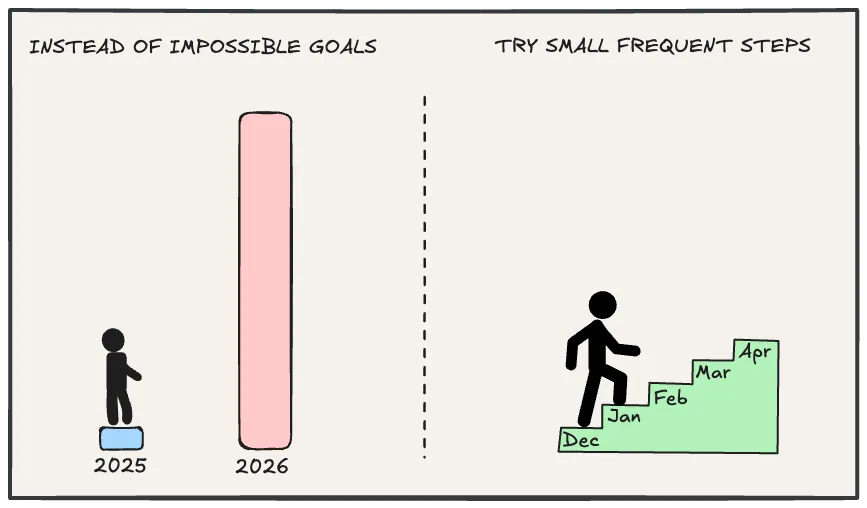
The higher the bar we set, the more likely we are to fail. We hope that in January we will magically transform almost every aspect of our lives. We bite off more than we can chew. Like trying to speed from 0 to 100 in mere seconds, it's a recipe for a quick crash.
Changing ourselves takes time. Instead of trying to change everything at once, we should take small steps over a longer period. Imagine you're trying to climb a mountain: would you rather face a series of small, convenient steps or one giant cliff?
We can use the "clean slate" effect in smaller doses. A quarter, a month, or a week all represent opportunities to start fresh.
The greater the change you want to make, the longer you'll need to invest in it. Consider this breakdown:
- Huge changes require a year or more - Changing your diet, lifestyle, job, or social circles.
- Medium changes can happen quarterly - Making one new friend, starting a course, or doing a digital detox.
- Micro changes can be monthly - Walking 10 minutes every day, reading 10 pages a day, or redesigning a room or workspace.
Personally, I think slow and steady wins the race. Start with small monthly goals and adjust them as you go. Accomplishing 7 out of 12 small goals is better progress - and better for our self-esteem - than failing at one massive goal.
Additionally, it's hard to predict how we'll respond to large changes. For example, starting a reading habit might trigger a writing or drawing habit you hadn't even considered.
Working with small goals and frequently updating them is a good way to advance while staying tuned to your changing self and reality. "Upon those who step into the same rivers, different and again different waters flow" said Heraclitus, often simplified as "you can't step into the same river twice". We are not the same person, and the river (our environment) has changed as well.
Predicting who you'll be a year from now is tough, but it's easy to trust the "tomorrow you" to take a small step forward - "A journey of a thousand miles starts from beneath one’s feet" (Lao Tzu).