Option 1
We often set impossible standards on the days when we have the least to give. Why do we treat our productivity like a constant when our actual capacity fluctuates so much?
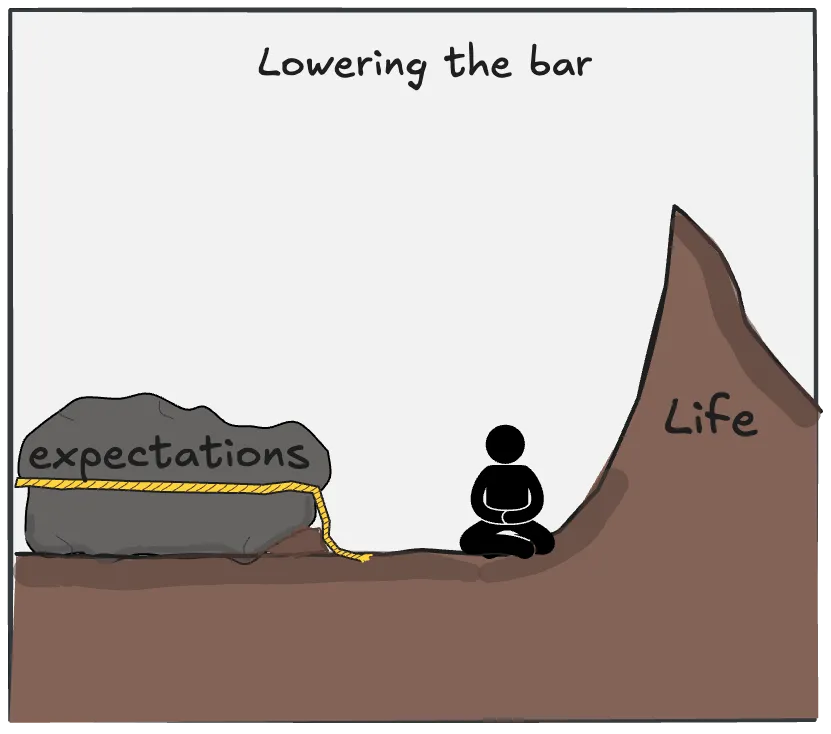
Impossible Standards
Some days are just too tough that they feel impossible, and somehow even on those days we set impossible standards for ourselves.
When life is overwhelming, we should match our standards to our actual capacity. The less time we have, the lower our expectations should be.
Progress can be constant even if the number of paces we take each day are different. Even if on some days it's none.
Life is a Marathon
You start the day with high hopes, and end up exhausted and disappointed, another day passed running around in circles, working hard just to stay in the same place.
In the past few weeks I felt like I was in corporate groundhog day. Wake up at 6 am, spend some precious time with my daughter before I start working, then when work ends it's already dark outside, a whole day passed in a blink of an eye, and now it's shower, bedtime, dinner, and time for bed myself, and repeat.
We all have days like this, where our goals are so detached from life that keeps on overloading us with more and more duties, responsibilities, and unexpected issues that we can't even afford to do anything but the bare minimum. Putting out fires all day but somehow still get burned, or burnout to be exact.
We're being pressured to do more, mostly by ourselves, while in reality it's just not possible. We wish for a pause button, to get a break, a bit more time, but physics be physics, it's still just 24 hours a day, so we end up every day exhausted trying to squeeze 30 hours worth of work to just 24.
Maybe if it's fine if you "sprint" for a single day, but life's a marathon. If we want to reach the end before crushing down, we have to slow down.
Lower the bar
I'll be honest - I'm writing this post mainly for myself, although I think it's relevant for many. I have very high and often impossible standards for myself, so I know how hard it can be to feel like you're stuck in place, or frustrated because you're failing yourself if you hadn't ticked all the boxes today, if you haven't completed all that you set out to do yesterday.
One of the best gifts I gave myself was the "mulligan" - a guilt-free pass to mark a habit as done, even if I skipped it. I'm not deferring to the next day, I'm genuinely skipping.
Why should you mulligan? Because you deserve it. Habits are good for keeping you on the right path, but that's true as long as you're able to move forward. You won't ask an injured person to run every day just because they habitually run. Of course we have to adjust based to the circumstances, so why don't do we it in other aspects in our lives?
There are times we need to recover, to slow down, to heal. In those times, it is perfectly okay to do less—or even nothing—and still call it a win. The fact that you're standing, that you survive day in day out is enough. You're doing your best, and that's the best possible outcome. Demanding any more is just ludicrous.
So how do we follow with the "bare minimum" mindset, and how do we make sure it doesn't turn into an excuse?
When "just barely" is Good Enough
Lowering the bar is harder than it looks, and it starts by saying "being good enough, is good enough." and actually believing it. That we don't have to do above and beyond to feel good about ourselves. Even the bare minimum is amazing.
Feel free to take as many mulligans as you want, but do keep track how many and how often are you taking. If you're taking a lot of mulligans, perhaps it's a sign that these habits aren't worth keeping.
And for the rest of your tasks - Identify your "Non-Negotiables" and only do what is vital for (mental) health and safety, block everything else.