Most of us believe we would make the most logical choice in a crisis, yet we often freeze when things get personal. There is a significant gap between knowing the facts and experiencing the reality of a situation. If rationality has clear limits, how do we prepare for the dilemmas that haven't happened yet?
Don't Think about it Too much
Let's start with a thought experiment. After all, few things are as relaxing as debating life-and-death scenarios.
Imagine you are at a train station. A train is approaching five people who are stuck on the tracks. Fortunately, there is a lever nearby that can switch the train to a different track, saving them. However, an innocent worker is on that second track. What do you do? Would you sacrifice one person to save five?
Most people would pull the lever. This is the classic "trolley problem," a dilemma explored in everything from TV shows to card games. The real problem emerges with a twist: Imagine that, instead of a lever, the only way to stop the train is to push a heavy person onto the tracks. Would you do it? Would you sacrifice one person to save five in this scenario?
In this case, most people say no. But why? In both scenarios, the outcome is the same: one person dies to save five. Many explanations exist: Some suggest it is about direct involvement - actively causing a death rather than it being an "accident." Others argue it is a matter of "out of sight, out of mind," as it is harder to ignore a death occurring right in front of you.
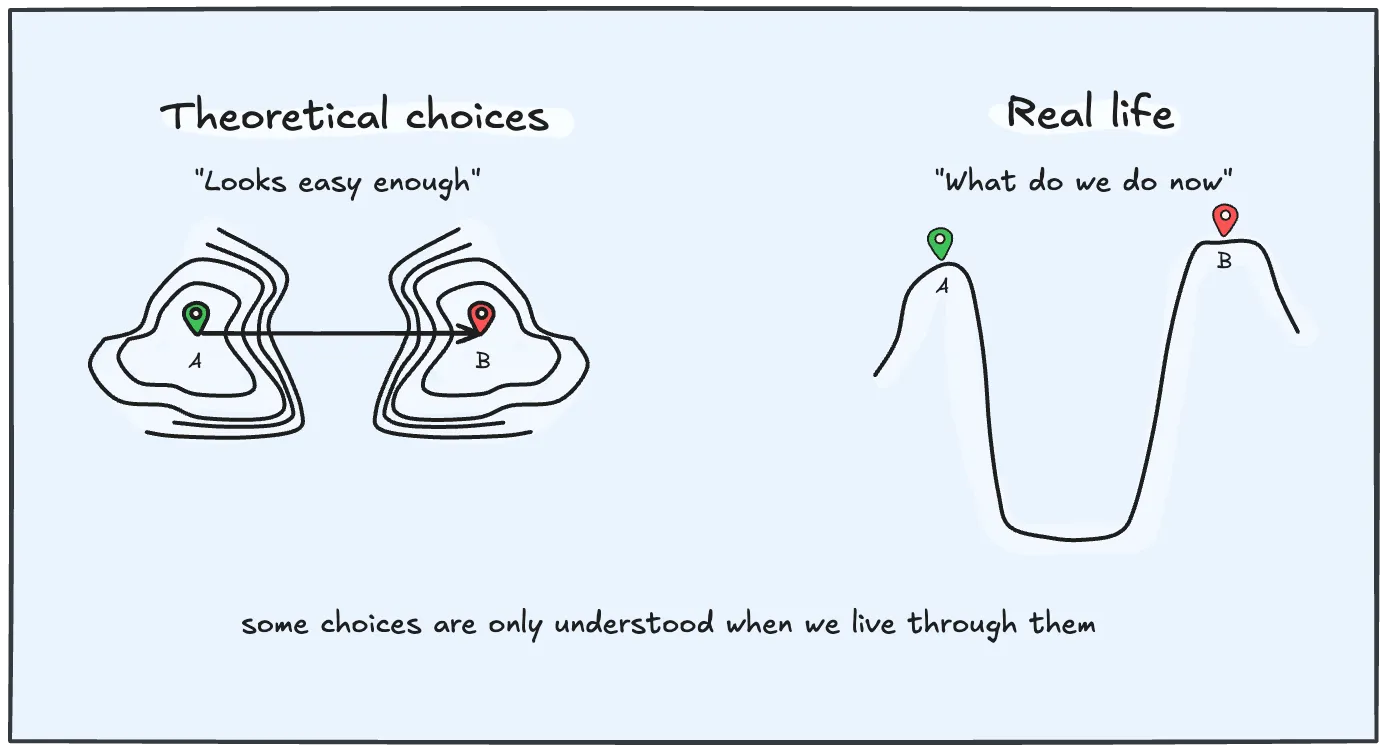
While these points are valid, the real issue is the "liveliness" of the situation. When we imagine pushing someone, it suddenly feels real, moving beyond a theoretical question about levers.
Consider a final twist. Instead of reading this from your sofa (or wherever you're reading this), try to immerse yourself in the situation. You are at the station with the lever in your hand. You see the five people who will soon realize the danger. No one else is around; there is only you and the lever.
What would you do? How would you feel?
Logic Can only Get You so far
Life decisions are never just cold calculations. Rationality has its limits.
This involves "experiential knowledge" - the idea that some things can only be understood by living through them. Emotions are inseparable from our decision-making, yet they often surface only in real life.
There's a famous experiment called "Mary's room". Imagine a person living in a black-and-white room who knows everything about the science of color. If she finally leaves the room and sees red for the first time, does she learn something new? Frank Jackson, the author of the experiment, argued that she does: "It seems just obvious that she will learn something about the world and our visual experience of it. But then it is inescapable that her previous knowledge was incomplete."
We are all Mary when it comes to decisions. We like to think we know ourselves and what we want, even criticizing TV characters for their foolish mistakes. But when it's our turn to step into the real world and make a choice, things look different.
If choices aren't just about being a better thinker, how can we make better decisions? We must realize that our choices are driven by emotions, values, and character traits that only "light up" when a dilemma is real
The ancient Greeks called these "virtues" - values we should strive to embody. Think of virtue like a muscle that only improves through experience. You cannot get into shape by watching videos, you have to do the work. We become kind by performing kind acts and brave by facing our fears
So Next time you face a difficult choice, ask yourself which virtue you are practicing. Focusing on how this prepares you for the future is much more helpful than any hypothetical thought experiment