Much of our daily choices aren't choices at all. We live on auto-pilot mode of the time, which often leads to regretful behavior. How can we bridge the gap between our good intentions and our actual actions? The answer lies in harnessing how our lazy brain works.
Another "wasted" Evening
You've likely heard the saying, "The road to hell is paved with good intentions." It’s that feeling you get after planning a productive evening, maybe just to read a book, but instead finding yourself doom-scrolling for hours.
This creates a gap between who we want to be and what we actually do. It can feel like we're not in control, that no matter how hard we try, we fall back into the same bad habits. To make matters worse, we then pile on judgment, blame, and disappointment.
How did we get here and what we can do about it?
Your Brain on Auto-pilot
Making choices is hard, and not just for indecisive people. Every decision is mentally exhausting. Our brain works hard to weigh the pros and cons; like a muscle, it gets tired if it's overused.
That's why our efficient (or lazy) brain looks for shortcuts. Instead of analyzing every pro and con for each decision, it first asks, "Have I been in a similar situation before? What did I do then?"
If the answer is yes, our brain skips the debate and jumps straight to action, repeating what we did last time.
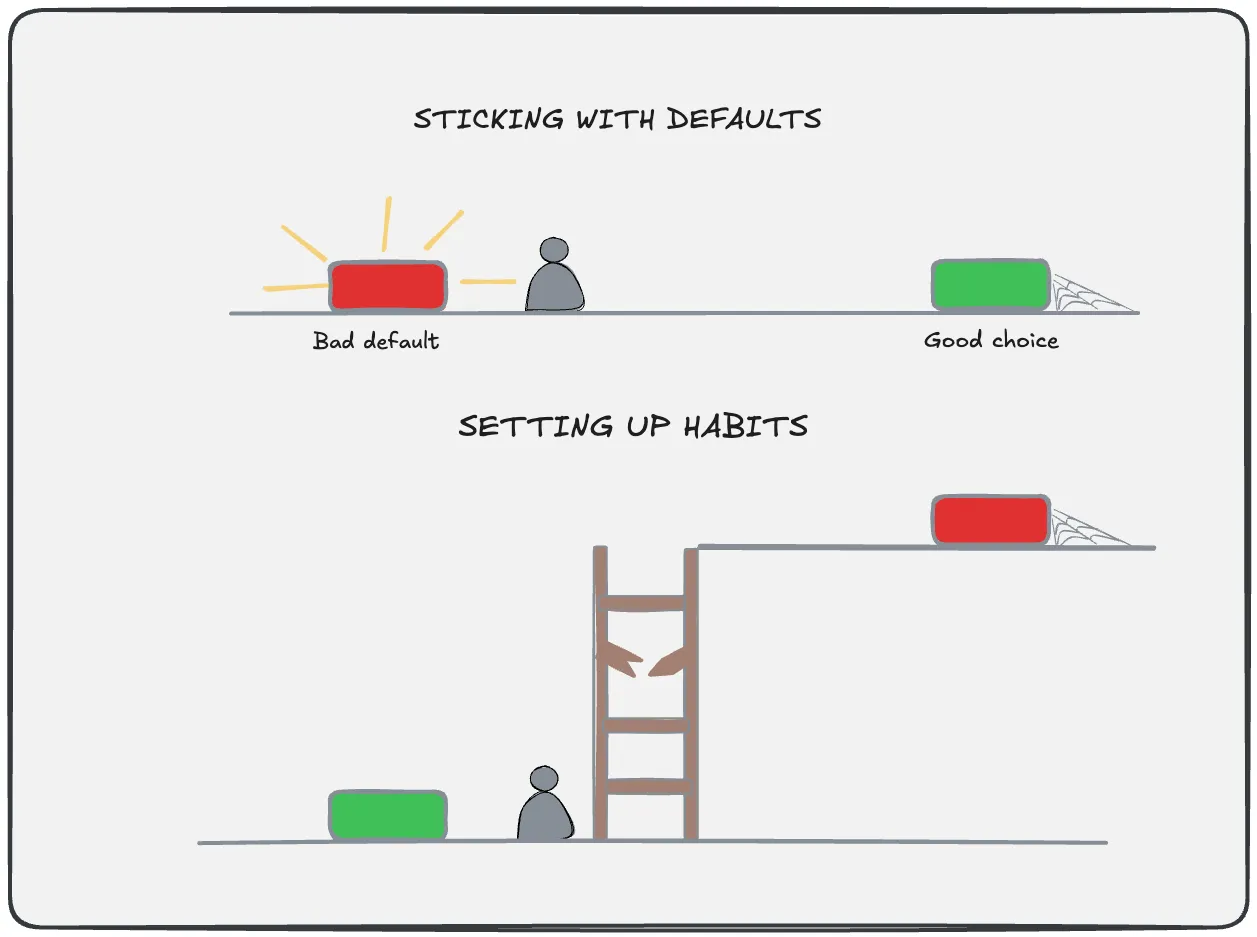
The problem, then, isn't that we make bad choices, but that we often don't make a choice at all. Our minds run on automated "if-then" instructions, so much of our daily behavior is de facto predetermined.
This makes habits self-reinforcing - the more we do something, the easier it is to do it again, and vice versa - the easier it is the more likely we will do it again.
But habits aren't always good. We might see a chocolate cake and suddenly "wake up" after eating half of it, filled with a sweet regret.
Habits are a double-edged sword. On one hand, the first time you do something is critical because it can set a new default. On the other hand, the good news is that making the right choice just a few times can be enough for it to stick, creating a new default that doesn't require constant self-discipline
So how can we build good habits more easily?
How to Easily Create Sustainable Habits
If you've read "Atomic Habits", the next part will sound familiar. If you haven't, I highly recommend it, but here is the short version. To build a habit, make it obvious, attractive, easy, and satisfying. To break a bad one, do the opposite: make it invisible, unattractive, difficult, and unsatisfying.
For example:
- Make it Easy - Reduce friction as much as possible. Lay out your gym clothes the night before, use tools like automated reminders, and don't overcommit. Even five minutes a day is enough to build momentum.
- Make it Attractive - Build your desire to start. Use strategies like "temptation bundling" - for example, only watching your favorite show while working out or listening to a guilty-pleasure podcast while cooking.
- Make it Satisfying - Reward yourself for maintaining your habit. Track your progress and make sure it doesn't get boring. You can increase the difficulty or change the setting from time to time to keep things interesting.
- Make it Obvious - Be specific about your goal, like "I will work out for 20 minutes every morning at 7:00 a.m." Use visible cues to remind you of the habit. Put vegetables at eye level, hide the candy, or place your gym clothes where you can't miss them.
That's the "secret sauce"? Habits?
Yup.
It might sound strange that something as small as hiding candy could change your identity as a "sweet tooth," but that's exactly how it begins. It’s not about waking up one day and immediately running a marathon. It's about taking a few steps each time, and one day, you’ll find you’ve covered that distance.
By switching our defaults habits from negative to positive, it becomes easier to make our actions match our values.
Sartre said, "Man is nothing else but what he makes of himself. Such is the first principle of existentialism." The small habits we build aren't just minor tweaks, they are the very actions we use to define and create who we are.