We often treat a "no" as a final verdict on our worth, but what if it is actually just a mismatched data point? Understanding rejection as a matter of fit rather than a character flaw changes how we approach new opportunities
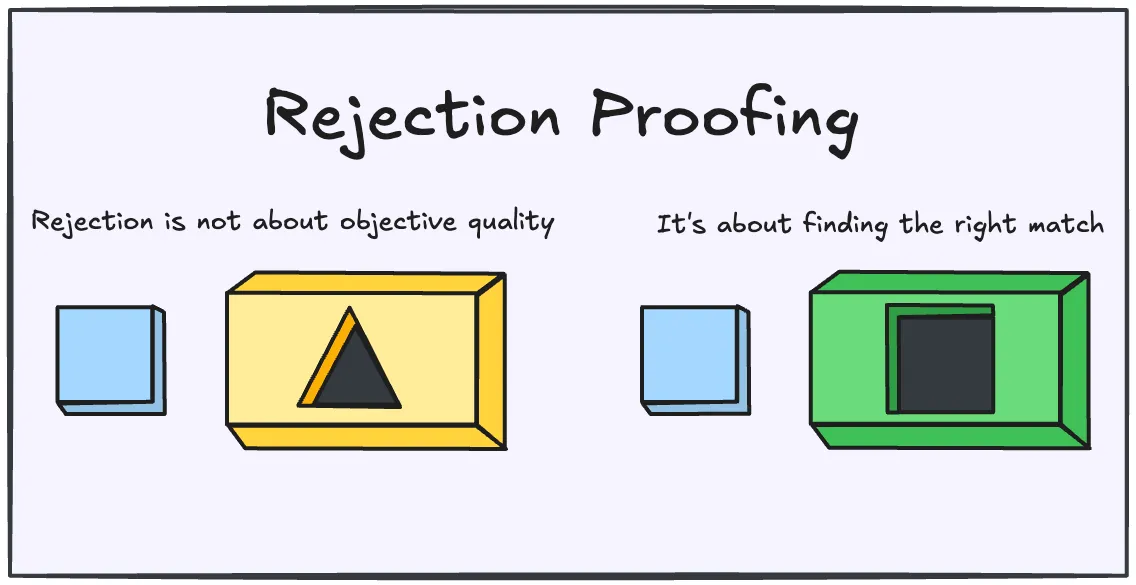
Why Rejection Isn’t About Your Worth
No one likes to hear "no", especially during moments like a job application when we are marketing ourselves. The word can feel like a sledgehammer thrown at us at full speed, crushing our hopes and self esteem.
It feels personal and cuts deep, making us feel unworthy of success. If we haven't felt like an impostor before, we do now.
It feels like the other side holds all the power. Through their words a reality is created. We find ourselves lingering on the thought, "If only they had said yes," imagining a future we will never have.
However, rejection is a matter of relative fit, not absolute worth. It is a "bad match," not a character flaw. You could be the best in your field and still hear "no" for countless reasons beyond your control. As Epictetus said - "Some things are within our power, while others are not. Within our power are opinion, motivation, desire, aversion... not within our power are our body, our property, reputation, office...".
If we view rejection is a matter of matching instead of ranking, e become more open to hearing it. A "no" doesn't mean you are incapable, it just means your skills, personality, or background are not what they need right now, and maybe this place is not the right one for you.
Don't Be Your Own Rejector
Before discussing how to handle rejection, let's address the first "no" we often hear: the one we tell ourselves. We shut ourselves down because our fear of rejection is stronger than our desire to seize opportunities.
We become our own worst critics. If you say no to yourself, your chances of success are zero. When you try, those chances increase. Even if you only have a 10% chance of success, trying 20 times raises your overall probability up to 87%!
It's their responsibility to say "no", it's our responsibility to ask.
Turning "No" Into a Conversation
Since rejection is about finding the right match, our goal should be to understand why someone said "no." This helps us identify better matches or areas to improve to increase our chances of getting a "yes".
Treat a "no" as information, be curious about it. It's painful, I know, it's like spreading salt on your wounds. But, viewing it from a place of curiosity converts it from a painful experience to something logical you can analyze. Spinoza, the most secular religious jew, said - "An emotion, which is a passion, ceases to be a passion, as soon as we form a clear and distinct idea thereof." We are either in learning mode or suffering mode, we cannot be in both at once.
This is your opportunity to get into the mind of those you wish to impress. Maybe they misinterpreted your intentions or misunderstood you, maybe there is a plan B that they would happily offer you, they just didn't know it's even relevant for you. We need to lean into the rejection because a "no" contains a lesson that makes our next "yes" more likely.
There's a classic experiment where children compete for a single orange, each having a different secret reason for wanting it. In the first scenario, they are not allowed to speak to each other, so they fight over it. In the second scenario, they can speak freely and realize one needs the juice while the other needs the peel. Both accomplish their goals.
Life is often not as clean and simple like that, but it's still more similar to the second case than the first. Most people are cooperative, which means turning a "no" into a yes is not that far fetched. Like the orange experiment, don't assume a refusal means your goals conflict, it could just be a miscommunication.
If an interviewer turns you down, there might be another relevant position in the company. Maybe they know others who might be interested, or they can keep you in mind for the future., At the very least, they can explain what they were looking for and how you were perceived. That feedback is worth gold, as it's specifically tailored for you, based on the perspective of the people you want to impress. So turning a "no" into a learning opportunity is not a bad consolation prize.
Becoming Rejection Proof
Put into practice:
▪ Start a "Rejection Log" to track how many times you ask for something, regardless of the outcome. ▪ When you hear "no," wait five seconds before responding to cool your ego. ▪ Always ask one follow-up question: "Is there something specific I could improve for next time?"
Self-Reflection Questions:
▪ Am I taking this personally? ▪ What is the one thing I can learn from this specific interaction? ▪ If I wasn’t afraid of a "no," what would I ask for right now?
The more you hear "no", the less power it holds over you. This frees you to seize opportunities that were once hidden.
It's time to become rejection proof.