We tell people to "be like a sponge" — to soak up everything around them. But that image gets the sponge exactly wrong. A real sponge is not a passive victim of its surroundings; it actively decides what flows through it and what it refuses to let in. The question is never whether the world acts on us, but whether we let it act on us by default or by design.
The Sponge Chooses
SpongeBob SquarePants, the character that I never thought I would reference in my newsletter, always opens his day with a smile. Despite others trying to trick him, messy situations that arise, and even fights with his best friends, he somehow manages to stay positive.
But wait, isn't he a sponge? I would imagine him being the opposite, perhaps more like Squidward, when bad things happen to him, he takes it all in, he "absorbs" the negativity all the way. So how come Spongebob stays happy no matter what?
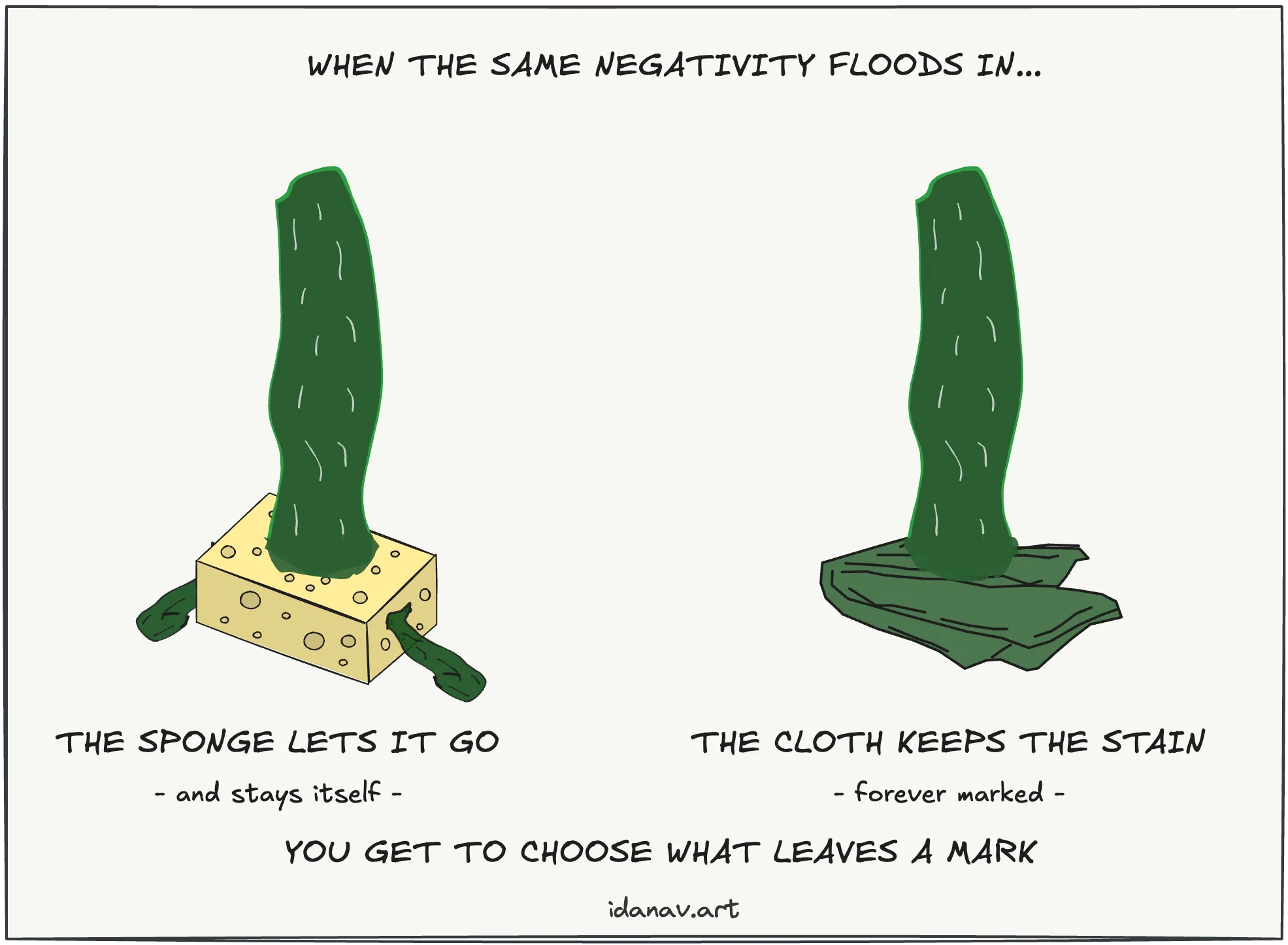
Real sponges are able to selectively choose what to take in, and what to leave out or throw away.
Taking everything in automatically is harmful to sea creatures as it is harmful to humans. When we are on autopilot, our attention shifts based on whatever tries harder to grab it. How we spend our time and attention dictates what our experiences, our life will be like, or as Chris Bailey said:
"We are what we pay attention to." — Chris Bailey, Hyperfocus
Filtering is a must-have skill in life, because it impacts everything else. No matter what we want to do in life, we first need the ability to do so, which means being able to control our attention and choosing what fills it and what stays out.
Flexible, Not Tough
Unfortunately, most social environments are not healthy. As they say in the media "if it bleeds, it leads". We are bombarded with borderline violent assaults on our attention. Whether it's news that shows us how terrible the world is, social media that shows us how unhappy/unsuccessful we are (or how much better we could be if only x...). From psychologists to game designers, entire industries are financially built around capturing your attention, so they don't "play nice". From the workplace to our home, we could be surrounded by toxic cultures everywhere.
Filtering those out is essential, but the real question is not whether we should do it or, but how. We'd like to imagine ourselves as these strong stoic figures that can stand tall against the incoming tidal wave of negativity through sheer willpower alone.
However, we can't rely on willpower to carry us through these temptations and distractions unharmed. There's a reason why Ulysses tied himself to the mast. Willpower fades the more we use it, so eventually we will fail.
"A rigid tree will be broken when the wind comes, yet the soft tree will bend and survive... ." — Bruce Lee, Be Water My Friend
We need to be flexible.
Curate What Nourishes You
Like a person who's annoyed at getting sunburned but keeps standing out in the open. Either put on sun screen or go to the shade. We can't expect to get different results from doing the same things.
Our flexibility is measured by our ability to adjust our environment or move to a better one. Against the wave of negativity, we need to learn to filter it out in advance.
It starts with cutting back on our exposure. If it means to delete social media apps, to put your phone away at night so that bad news won't be the first thing you see in the morning, or maybe even cut ties with toxic people in your life.
But filtering out the harmful is only half the job - the defensive half. The other half is offense: deliberately increasing the bandwidth of what makes us better.
Since bad things are much easier to notice, it makes this job much harder. Think about what or who in your environment has a positive impact on your life. What makes you happier, what pushes you to be better, what makes you feel alive and whole.
Once you find these things or these people, keep them close. Cultivating your environment is orders of magnitude more effective than relying on willpower to carry you through hardship or maintain commitment.
We tend our inputs the way we'd tend a garden, because over time that affects what will grow - a weed or a flower. The environment we shape also shapes back who we are through freeing our attention and allowing us to focus on what matters:
"Your soul takes on the color of your thoughts." — Marcus Aurelius, Meditations
The Road ahead
So how can we be more like SpongeBob?
- Replace, don't just remove - For every input you cut, queue a better one (a book, a newsletter, a mentor) so the freed bandwidth fills with something you like, instead of just making room for more noise.
- Set an "attention timer" - Before diving into a temptation or distraction, such as social media or news outlet, decide in advance how long you're going to be on those platforms. There are even dedicated apps/tools that will close it for you when the timer ends.
- Name it to tame it - When something provokes you, name it out loud ("this is meant to anger me") before responding. Naming converts a reflex into a choice.